Over the past decade, the foundations of global economic and financial systems have changed profoundly. The boundaries between security, technology, and finance have blurred, and tools once developed for intelligence and warfare have moved into the heart of the civilian economy and onto the desks of senior executives and boardrooms.
This shift was at the center of the 81st Annual Convention of SFNet (Secured Finance Network), held in November 2025 in Los Angeles. The conference is considered one of the leading global forums for in-depth discussion of economic stability, digital security, artificial intelligence, and risk management in an era of accelerated technological change. Its importance was underscored by the participation of sponsors such as Bank of America, Wells Fargo, Citibank, Deutsche Bank, and HSBC, reflecting the fact that these discussions are no longer theoretical but directly influence strategic decision-making across the global financial system.
Among the speakers was Doron Amir, Global Cyber Warfare Expert and CEO of CyTaka, who presented a perspective combining experience from intelligence and security operations with the challenges now facing financial institutions. Amir focused not on technology in isolation, but on how organizations must think and operate in a world where advanced technologies can serve both defense and attack.
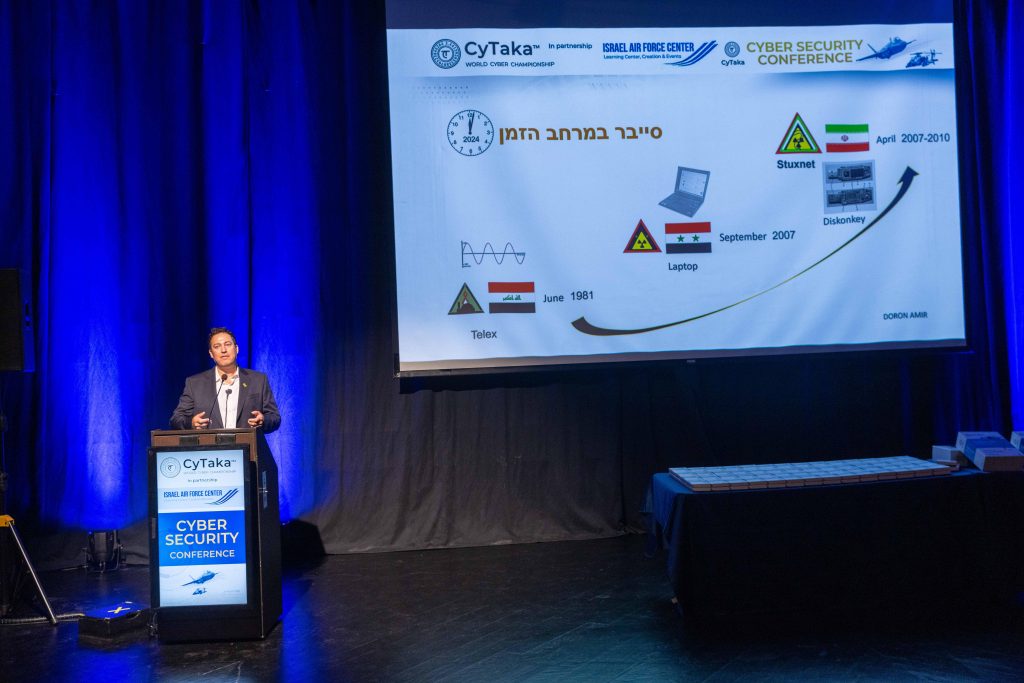
He illustrated his argument through lessons drawn from past cyber operations, including the 2010 Stuxnet attack on an industrial facility linked to a nuclear program. That operation demonstrated for the first time how digital code could cause sustained physical damage without conventional military force or early warning. The broader lesson, Amir emphasized, was not about copying military tools, but about understanding mechanisms such as stealthy intrusion, long-term persistence below detection thresholds, and the manipulation of data and processes. In the financial sector, similar dynamics can quietly undermine stability, trust, and executive decision-making.
Amir described how cyber attacks are increasingly enhanced by artificial intelligence. Unlike traditional attacks based on known vulnerabilities and fixed patterns, AI-driven attacks adapt in real time, learn their target environment, and constantly change behavior, making detection and mitigation far more difficult. At the same time, many attacks still rely on relatively simple techniques such as voice spoofing, impersonation, and phishing, often involving people who are unaware they are part of a coordinated operation.
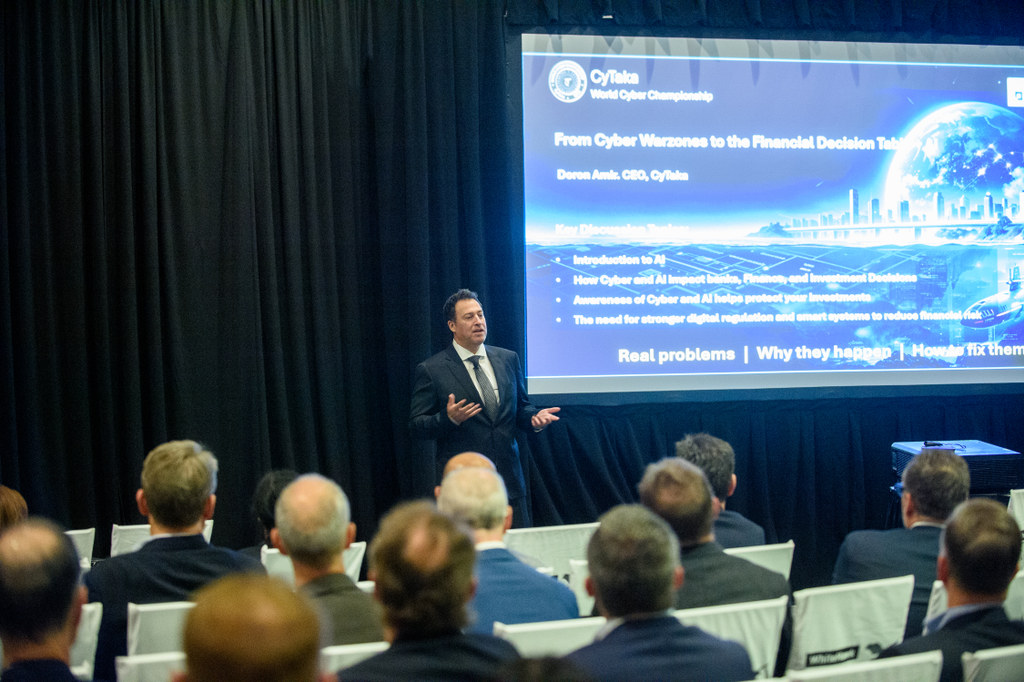
In this environment, traditional controls such as verbal passcodes for approving transactions are rapidly losing relevance. Referring to the logic behind the Turing Test, Amir argued that when humans can no longer reliably distinguish between a person and a machine, trust itself can no longer function as a security mechanism.
He also pointed to a broader shift in cyber doctrine, from state-to-state confrontation to operations targeting individuals, personal devices, and private digital spaces, as illustrated by programs such as Pegasus. This evolution raises new questions about responsibility, protection, and the impact of cyber capabilities on civilian life and economic activity.
Amir warned that the growing integration of artificial intelligence and automation into financial trading systems also carries risks. Opaque, insufficiently supervised algorithms can turn from operational tools into sources of systemic risk. At the global level, he noted, even advanced systems and decentralized ecosystems such as crypto are not immune to sophisticated attacks.
His conclusion was clear: technology alone is not enough. Effective risk management requires regulation, international cooperation, and aligned incentives to ensure that innovation strengthens stability rather than undermines it.
Amir closed with a reflection that captured the spirit of the era: artificial intelligence does not replace people; it accelerates those who know how to lead it.”In a world where technology becomes trust and data becomes currency, cyber and artificial intelligence are shaping the foundations of the new economy.”