
In the early years of tech innovation, software development was driven by a simple cultural assumption that was born in Silicon Valley: that speed equals progress. Entrepreneurs, founders, and developers were encouraged to move fast, experiment freely, and ship continuously. Restraint, social consequences, or legality were often treated as obstacles to overcome or avoid; necessary evils at best, innovation killers at worst.
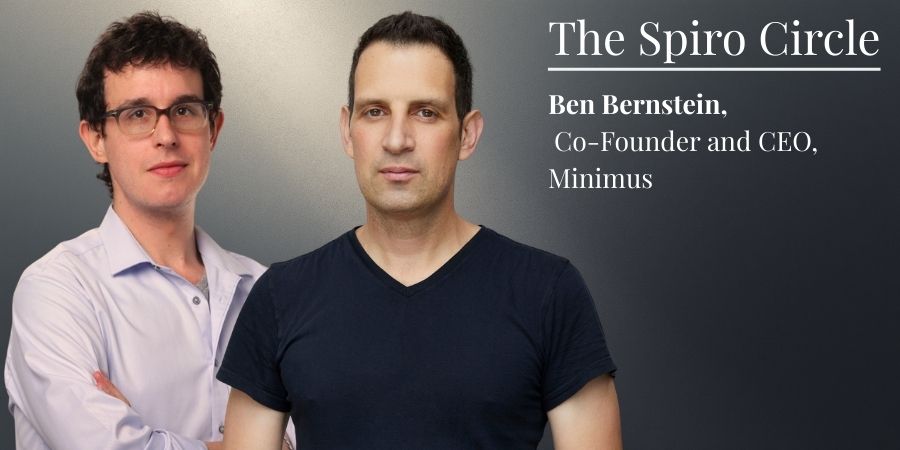
My latest conversation showed me how that era is coming to its end, and that a more conservative movement is growing from the ashes of the Wild Wild West of progress that saw growth encouraged to ignore guardrails or accountability. According to Ben Bernstein, co-founder and CEO of Minimus, the software world is now entering a period of ideological correction, one that closely mirrors what happened with social media and what the LLM era is susceptible to falling into as well. “We identified the problem the first time,” Bernstein says of his first company, Twistlock. “But what was interesting is that we didn’t solve it the first time… Apparently, just identifying the problem is not good enough anymore.”
His previous company, Twistlock, is a cloud-native security platform with security and compliance coverage for users, applications, data, and the cloud technology stack. It helps security teams see vulnerabilities created by cloud-native development and containers, but the team realized that visibility alone didn’t stop the explosion of risk. “There are thousands and thousands of issues in every little application,” he said.
Bernstein argued that the issue isn’t malicious developers or bad code, but the excess of code that can cause security issues. “The problem isn’t malicious code,” Bernstein says. “It’s unnecessary code.” This realization has driven the philosophy behind Minimus, which builds secure, minimal container images designed to reduce attack surface by design. After Twistlock was acquired by Palo Alto Networks in 2019 for approximately $410 million, Bernstein got to work on his next company: one that would set out to solve the problem identified by his first.
Minimus recently announced a whopping $51 million Seed round to “kill” up to 95% of software vulnerabilities by replacing bloated containers with secure, minimal images, slashing risk and development time across the software supply chain. The round was co-led by YL Ventures and Mayfield, with participation from Bernstein, Dima Stopel, and John Morello.
But Minimus is less interesting as a product than as a sign of the times: a broader shift in how the industry thinks about freedom and responsibility. In our conversation, we discussed how the past decade has become somewhat of a pendulum swing: In the early 2000s, security and IT teams held tight control, slowing development. Then came cloud, containers, and open source, and the pendulum swung hard in the opposite direction.
“Developers got maybe too much freedom,” he says. “And now they see, ‘my God, these are the consequences of what I just did.’” The result is familiar to anyone who followed the arc of social media. Platforms like Facebook, Instagram, and recently X were optimized for engagement first, governance later. Only later did we realize that their push for scale without guardrails produced systemic harm to young people.
Bernstein draws the parallel explicitly: “When you get too much freedom, it’s just too much”. What’s changed is who is asking for constraints. “It’s not even the security team asking anymore,” Bernstein notes. “It’s actually the people who want to innovate. This is because developers now spend their time chasing vulnerabilities, patching dependencies, or responding to issues that never should have existed in the first place. “We cannot allocate 50% of our time to just maintain existing software,” Bernstein explained. “Because it actually stifles our innovation.”
In this sense, Minimus represents a broader reckoning on what it means to move fast. Ideologically, techies are starting to recognize that speed without structure doesn’t scale. “Velocity can lead to chaos,” Bernstein says. “And chaos is not progress. Chaos is regression.”
Just as social media eventually discovered that moderation wasn’t always censorship, software is now discovering that guardrails aren’t necessarily anti-innovation. They are what make innovation sustainable.