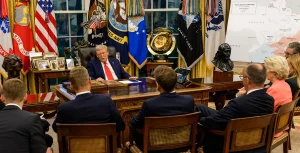

The meeting held this week in Naqoura – bringing together Israeli representatives, Lebanese civilian officials, and senior American envoys – did not appear dramatic to the outside viewer. There were no historic handshakes, no sweeping declarations, and no promises of a new beginning. Yet for anyone examining the encounter through the lens of negotiation, rather than geopolitics alone, something far more significant was taking place: a structured dialogue unfolding even though the actor widely seen as holding the real leverage in Lebanon, Hezbollah, was not in the room.
In complex business negotiations, this dynamic is surprisingly familiar. A powerful stakeholder influences every detail of the process, yet never enters the meeting. A controlling shareholder, external regulator, or decision-maker standing behind the scenes sets the boundaries of what is possible. The Israel–Lebanon channel reflects this same pattern: a negotiation conducted under the shadow of an actor whose influence is widely considered to exceed that of the formal parties at the table.
The first task in any negotiation is recognizing leverage. Lebanon’s severe economic collapse has created a rare moment in which incentives are shifting. In business, crisis is not only a threat, it is leverage. When an organization is under strain, its openness to restructuring and recalibrating increases. Likewise, Lebanon’s urgent need for stabilization, economic relief, and functioning infrastructure means that even incremental calm becomes tied to its survival. Israel, alongside international partners, therefore holds a form of leverage that is not military but structural: the ability to influence Lebanon’s trajectory toward stability, or further decline.
But leverage alone does not move negotiations. Equally important is the cost of no-deal. In many negotiations, this is the decisive factor. Here, the price of doing nothing is steep for every party. Lebanon faces continued currency collapse, failing public services, weakening state authority, and deepening social unrest. Israel confronts a volatile northern border shaped not by the Lebanese government but by Hezbollah, whose military strength is widely assessed as exceeding that of the Lebanese Armed Forces. And for the United States, the mediator, every unmanaged flashpoint limits its diplomatic bandwidth and complicates broader regional stabilization efforts.
In negotiation terms, stalemate is costly. When inaction becomes more expensive than incremental cooperation, even adversaries begin exploring limited, carefully structured understandings.
And the effects ripple outward. In interconnected negotiation arenas, stability in one arena alters leverage in another. Neighboring Arab states – Jordan, Egypt, and Gulf countries – see any functioning dialogue between Israel and Lebanon as a model of tension-management instead of tension-escalation. For European actors concerned with energy routes and regional resilience, a quieter northern border is a strategic asset. Even regarding Gaza, the implications are clear: Hamas, like Hezbollah, has often leveraged parallel pressure points. When the northern arena stabilizes, Israel gains greater negotiation capacity in the southern arena. In negotiation language, the entire bargaining environment shifts, shaping the behaviour of actors who never entered the room.
This leads to the final foundational principle of complex negotiation: sequencing. Fragile conflicts do not allow for grand bargains. They require careful, incremental construction. First comes friction reduction: communication channels, clarified red lines, and mechanisms to prevent accidental escalation. Next come small, visible economic steps that improve civilian life. Only then can broader layers of cooperation be added, contingent on proven implementation of earlier commitments.
This mirrors the logic of high-risk business partnerships. No one opens with the “big deal.” Instead, both sides build operational trust: trust founded not on emotion, but on repeated fulfilment of obligations. Over time, these accumulating steps reshape expectations, behaviours, and ultimately, the strategic landscape.
So, what can the talks achieve, and what can they not? They cannot dismantle Hezbollah, restore Lebanon’s economy overnight, or eliminate the volatility of the northern border. But they can alter incentives. They can make escalation more costly than maintaining calm. They can strengthen state institutions at the margins. And they can begin shifting the calculations even of the actor widely seen as holding the real leverage, by reshaping the environment around him.
While Naqoura is neither a peace agreement nor an immediate breakthrough, it holds the potential to become something far more consequential. In negotiation practice, the moments that eventually shift an entire conflict system rarely begin with fanfare — they begin with small, deliberate steps that quietly rewrite incentives over time. Naqoura may be exactly that kind of opening: a modest start that carries the hope, and the strategic possibility, of becoming a game-changing foundation for a different future.
Sometimes, the most transformative act is simply choosing to talk – quietly, cautiously, and without illusions – even when the actor widely seen as holding the real leverage is not in the room. It is in these understated beginnings that the architecture of long-term change is often built.
Yael Chayu is a global business negotiation expert, keynote speaker, and strategic advisor to executives across industries. She is a doctoral researcher in Behavioral Economics at Reichman University, where she also serves as Academic Director of the Business Negotiation Program at FORE Executive Education.
Forbes Israel Contributors are independent writers selected by the Forbes editorial team, experts in their fields, providing current commentary and reviews in their area of expertise. The content is their own and under their responsibility and is not sponsored content.