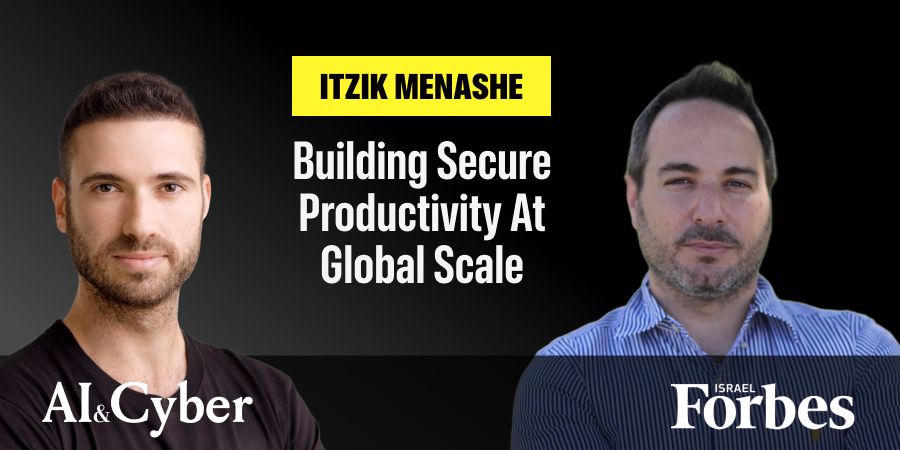
Few roles in enterprise technology are as paradoxical as that of the modern CISO. Itzik Menashe, Chief Information Security Officer and Global VP of IT Productivity at Telit Cinterion, has lived that paradox for nearly two decades. “Half of my role is to secure the organization,” he told me, “and the other half is to make sure our people can move fast. These two goals constantly collide.”
That tension—between security and productivity—has defined Menashe’s philosophy. For him, cybersecurity is no longer about locking systems down; it’s about enabling business securely. “A CISO can’t be a blocker anymore,” he said. “We have to be enablers. Our job is to understand what employees need to do their work and make sure they can do it safely and easily.”
Over 18 years at Telit, Menashe has overseen 24 global M&As, built a unified security infrastructure across 70 countries, and led one of the world’s largest IoT connectivity networks, linking hundreds of millions of devices. “Each acquisition brought a new level of complexity,” he explained. “Different cultures, regulations, and technologies—Germany with workers’ councils, Italy, where locating specialized talent is often more challenging, the U.S. with speed expectations, and Israel where competition for skilled professionals is high. My team’s mission is to make all that run securely, as one system.”
To manage that scale, Menashe built a hybrid model where his security team doubles as an IT productivity group. The same engineers who deploy collaboration tools also harden endpoints, integrate SaaS posture management, and handle data governance. “In practice, our firewall guy is also our network productivity guy,” he laughed. “We built a structure where IT and security don’t just coexist—they’re the same thing.”
Beyond his operational role, Menashe has become a fixture in Israel’s cybersecurity ecosystem, sitting on advisory boards for Glilot Capital Partners, Team8, Bain Capital and Merlin Ventures. Through these relationships, he mentors early-stage founders building the next generation of security tools. “Every week I meet entrepreneurs,” he said. “I’ve probably seen every startup in Israel’s cyber scene over the past decade. The best ones listen deeply—they don’t fall in love with their idea. They ask what real CISOs actually need.”
That feedback loop has become essential for innovation. Menashe describes it as a triangle: investors, founders, and the field. “The field—CISOs and practitioners—is often the missing piece,” he noted. “We bring the reality check. A startup can spend a year building a brilliant idea that nobody can actually deploy. Our job is to ground them, to help them pivot ten degrees left or right so they hit a real pain point.”
He points to the same collaborative spirit that others in this series—like Dorit Dor of Check Point and Shahar Maor of IronSource—described as Israel’s secret advantage: a security community that acts more like a union than a competition. “We all share,” Menashe said. “If I’m testing a new technology, my peers are too. We save each other months of work. In the end, that knowledge also feeds back to the startups.”
When I asked him for advice to founders entering the space, his response was immediate: Don’t fall in love with your idea. Fall in love with the problem. “Meet as many CISOs as you can, listen carefully, and measure ROI early,” he said. “Work with design partners who truly care about your success, not just a discount.”
In Menashe’s world, the future of cybersecurity is not about adding more walls—it’s about designing smarter intersections between safety and speed. “Security that slows the business is obsolete,” he concluded. “Security that accelerates it—that’s the future.”
About Michael Matias:
Michael Matias is the CEO and Co-Founder of Clarity, an AI-powered cybersecurity startup backed by venture capital firms including Bessemer Venture Partners and Walden Catalyst. Clarity develops advanced AI technologies protecting organizations from sophisticated phishing attacks and AI-generated social engineering threats, including deepfakes. Before founding Clarity, Matias studied Computer Science with a specialization in AI at Stanford University and led cybersecurity teams in Unit 8200 of the Israel Defense Forces. Forbes Israel recognized him early on, naming him to the exclusive 18Under18 list in 2013 and the Forbes 30Under30 list thereafter. Matias authored the book Age is Only an Int and hosts the podcast 20MinuteLeaders.