
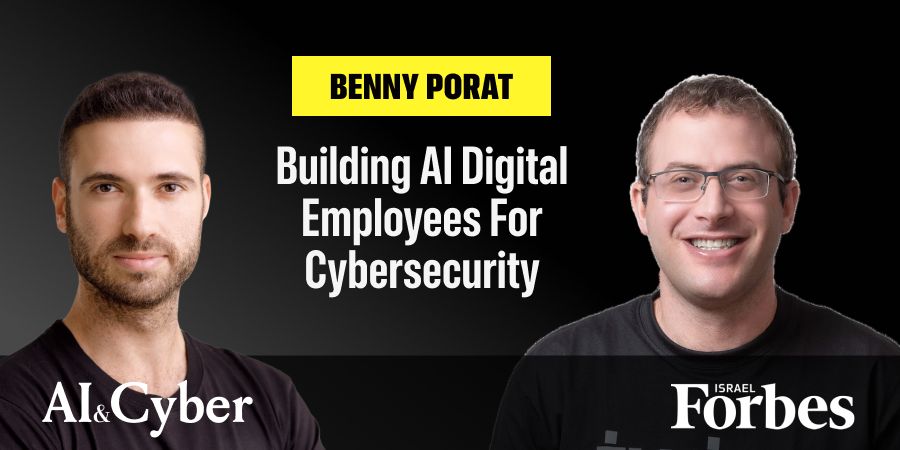
When you sit down with Benny Porat, you feel the engineer’s mindset immediately: a deep instinct to open things up, take them apart, and rebuild them stronger. That instinct—cultivated since childhood, when he and his family would repair broken gadgets rather than replace them—has defined his entrepreneurial journey from co-founding Claroty to now leading Twine Security.
Porat recalls that growing up, there was never the option to say, “It’s broken, buy a new one.” Instead, his father would insist they fix it. That hands-on resilience became a family trait, one Porat is now determined to pass on to his own kids. “The most important gift you can give a child,” he reflected, “is a sense of capability. To believe they can solve problems on their own.”
That ethos carried him through Claroty, one of Israel’s most successful cybersecurity startups, where he served as CTO. Claroty pioneered operational technology (OT) security, protecting critical infrastructure from industrial cyber threats. The company’s trajectory revealed a paradox Porat couldn’t shake: even when technology detected risks, organizations often struggled to remediate them. “Technology alone can’t close the loop,” he told me. “Execution depends on people and processes.”
That realization sparked his next venture—Twine Security—where Porat and his team are building what he calls AI Digital Employees. These are not generic AI copilots but contextual experts, embedded in security workflows, who can analyze risks, understand organizational context, and interact with humans to drive resolution. “In security, you don’t just need findings—you need actions,” he said. “AI Digital Employees bridge that gap.”
Why start with identity? “Identity is the new perimeter,” Porat explained. “Every enterprise today faces identity-driven attacks. Starting here gives us the toughest, most urgent challenge.” From there, Twine envisions a growing team of AI Digital Employees—each a domain expert, collaborating just like human colleagues. “In the near future,” he predicts, “organizations will employ more AI Digital Employees than human ones.”
Porat is candid about the cultural challenge: building trust. Just as you wouldn’t hand a new junior analyst the keys to production systems on their first day, AI employees must earn confidence gradually. At Twine, they design onboarding frameworks where AI begins with safe, low-risk tasks and progressively assumes greater responsibility as it proves reliability. “It’s the same as hiring a new teammate,” he said. “Trust is built layer by layer.”
This theme of trust in the age of AI is one that has come up repeatedly in my conversations for this series. Ofer Ben-Noon of Palo Alto Networks spoke about browsers becoming the new frontline, where invisible, AI-driven defenses must operate seamlessly in the background. Dorit Dor of Check Point emphasized that organizations must move from reactive alerts to real-time AI prevention. And Yoni Efrati, speaking about financial infrastructure, warned that the stability of entire economies now hinges on adopting AI security measures fast enough. Porat’s vision of AI Digital Employees fits squarely into this narrative: a move from passive tools to proactive, trustworthy teammates.
Where does this go in three to four years? Porat imagines security teams orchestrating not dozens of fragmented tools but a workforce of AI Digital Employees that continuously collaborate, contextualize risks, and take action before threats escalate. “Think of a war room that’s always on,” he said, “but instead of dozens of tired humans, you have specialized AI employees handling incidents at scale.”
It’s a bold reimagining of cybersecurity. And like his father’s insistence on fixing rather than discarding, Porat’s philosophy remains clear: don’t accept broken processes—rebuild them until they work. If Claroty was about protecting machines, Twine is about empowering organizations to finally let their machines protect themselves.
About Michael Matias
Michael Matias is the CEO and Co-Founder of Clarity, an AI-powered cybersecurity startup backed by venture capital firms including Bessemer Venture Partners and Walden Catalyst. Clarity develops advanced AI technologies protecting organizations from sophisticated phishing attacks and AI-generated social engineering threats, including deepfakes. Before founding Clarity, Matias studied Computer Science with a specialization in AI at Stanford University and led cybersecurity teams in Unit 8200 of the Israel Defense Forces. Forbes Israel recognized him early on, naming him to the exclusive 18Under18 list in 2013 and the Forbes 30Under30 list thereafter. Matias authored the book Age is Only an Int and hosts the podcast 20MinuteLeaders.