
ForbesPro
The internet hasn’t gone dark, but for the systems designed to secure it, it increasingly feels that way. As encryption becomes standard, and as AI-generated traffic, machine-to-machine communication, and rapidly evolving applications reshape how data moves, traditional approaches to visibility are reaching their limits. What was once a landscape of human-driven activity is now dominated by dynamic, autonomous interactions that are far harder to interpret.
Misha describes this shift as a growing crisis of digital blindness. We spoke with him about what’s driving it, how his company is addressing it, and why a new approach to visibility is becoming critical for both business and national security.
You’ve described the problem as “digital blindness.” What does that mean for those responsible for protecting networks?
Imagine being responsible for the safety of every highway in your country, and overnight, every vehicle becomes invisible. Cars still move, trucks still carry goods, but you can no longer see what’s on the road or who’s driving. The result wouldn’t just be discomfort, it would be chaos. Traffic laws couldn’t be enforced, accidents would occur without warning, emergency response would slow, and criminals could move undetected. Over time, trust in the entire system would erode.
That’s increasingly the reality for governments, telecom operators, and large enterprises.
Encryption is a major factor today, roughly 90% of global internet traffic is encrypted. But the challenge goes beyond encryption. Networks are no longer primarily human-driven; they are shaped by machines, AI-generated traffic, APIs, and highly dynamic workloads that appear and disappear in seconds.
The result is not just a loss of visibility, but a loss of control. Security teams struggle to detect threats early. Operators find it harder to enforce policies. Fraud, data exfiltration, and misuse of infrastructure become harder to identify in real time. Regulators face growing gaps in oversight, and at a national level, resilience is reduced.
Traditional inspection tools were built for a world where traffic could be read in clear text. Today, relying on them is like trying to understand a sealed letter by looking at the envelope. The network still functions, but our ability to understand and protect it has fundamentally changed.
If visibility is the problem, why not decrypt the traffic, inspect it, and re-encrypt it?
If we stay with the highway analogy, that would mean stopping every vehicle at a checkpoint, opening every truck, inspecting every package, and then sending it on its way. It sounds like control, but in reality, it would create bottlenecks, introduce new risks, and disrupt the system.
Encryption is not just a technical feature; it is a trust mechanism. It protects financial transactions, personal communications, intellectual property, and critical infrastructure. Breaking it at scale, even with good intentions, turns networks into interception points, expands the attack surface, and raises legal and ethical challenges. Most importantly, it erodes trust.
But it also doesn’t solve the full problem. Traffic today is dynamic and machine-driven. Even if you could inspect everything, you would still struggle to understand behavior and intent.
So the real question becomes: how do you secure the highway without stopping every vehicle? How do you detect anomalies and enforce rules without opening every truck??
So how do you actually achieve that?
Think about how you recognize someone in a crowd without seeing their face. You notice how they walk, their posture, the rhythm of their movement. Even from a distance, you can tell who they are, or when something feels off.
Data behaves the same way. Even when encrypted, it still “moves” in distinctive ways. Every application, protocol, and threat has a behavioral signature, not in what it says, but in how it behaves. Timing, flow patterns, and interactions create a kind of digital body language.
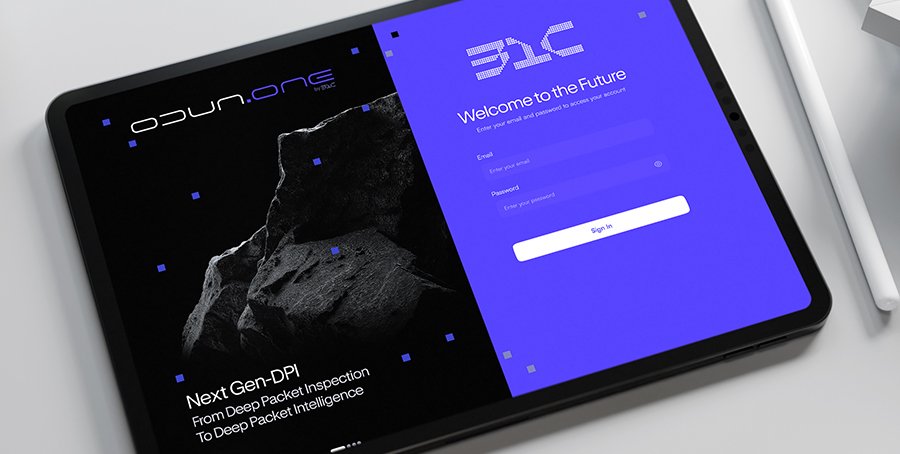
We’ve taught ODUN.ONE to read that body language at scale. Instead of opening the “sealed envelope,” we focus on behavior, recognizing patterns, classifying activity, and detecting anomalies without accessing content. This creates a new form of visibility based on perception rather than inspection.
ODUN.ONE classifies more than 3,500 applications with around 98% accuracy, processes up to 1.2 terabits per second on standard hardware, and runs entirely on-premises. It’s a fundamentally different way of seeing, aligned with how modern networks behave
You’ve touched on national security. How does this relate to digital sovereignty?
Digital infrastructure is now as critical as energy or transportation, and sovereignty matters. Nations need to understand and protect what flows through their networks without compromising privacy or relying on external actors.
Today, that visibility is either lost or outsourced. Breaking encryption undermines trust. Relying on external analysis creates dependency.
What’s changing now is that visibility can be restored in a fundamentally different way, one that is privacy-preserving, scalable, and deployable entirely within national or organizational boundaries. That means governments and operators can regain situational awareness of their networks without exposing sensitive data or relying on foreign infrastructure.
This is more than a technological shift; it’s an enabler of digital sovereignty. It allows nations to see their infrastructure again, enforce policy, and respond to threats on their own terms.
ForbesPro is Forbes Israel’s Paid Promotional Content Brand