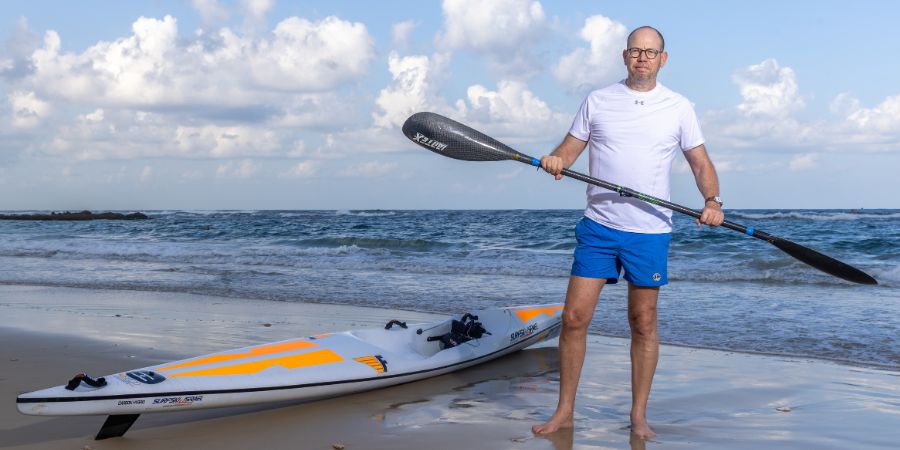
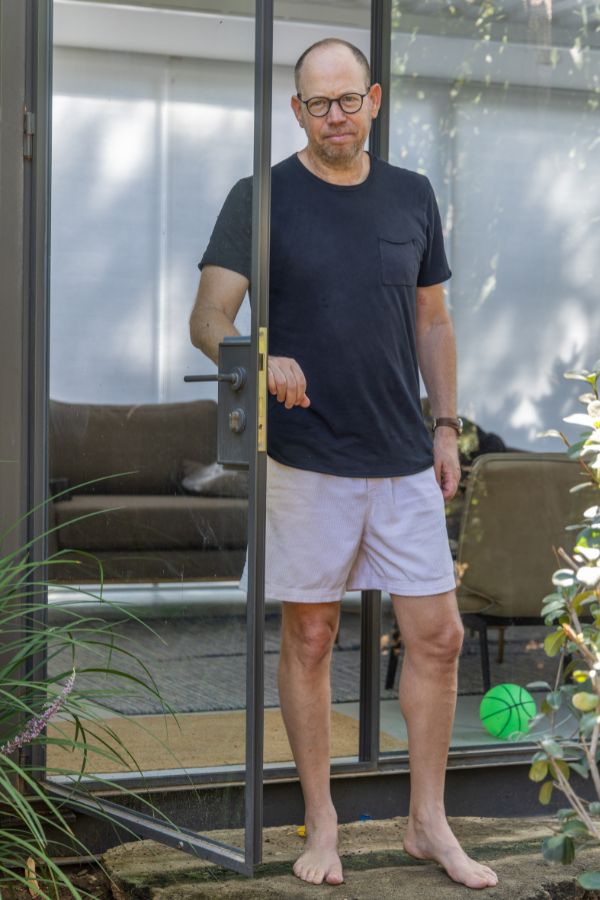
Young entrepreneurs looking to meet Gili Raanan and land a seed investment from Cyberstarts – the venture capital fund he leads, and one of the most successful in the world – need to make their way to his home in Michmoret. There, far from the center of Tel Aviv’s tech scene and its skyscrapers, the crucial decisions are made that drive one of the world’s most successful cybersecurity-focused venture funds.
Anyone who has followed his work over the past two decades shouldn’t be surprised. Raanan, as the world has come to learn, is no ordinary investor. Just as he does when choosing business partners or the entrepreneurs his fund backs, he goes against the grain in the small details of life too, elegantly sidestepping conformist thinking, stereotypes, or rigid conventions.
He set up the main office of the company he founded, after leaving a successful partnership at investment giant Sequoia Capital, in a “container” still standing today in the middle of his backyard – a shipping container he converted into an office and meeting room. You won’t find designer sofas, antique wooden tables, or expensive artwork there – just a plain-looking couch and a few ordinary armchairs, sitting between a whiteboard and sunshades that occasionally let in a glimpse of the view. It’s there, surrounded by a lush garden and the mango trees he grows, that the man now considered one of the world’s leading venture capitalists built a global cybersecurity investment empire.
“Part of the decision to build the container was that I wanted to really get to know people, to know them deeply,” Raanan explains the rationale behind the unusual choice. “Our offices at Sequoia were spectacular, everything there was polished,” he recalls. “I remember that as a young guy, that was really intimidating. So I decided to build something that would be the exact opposite of that. As calm as possible, not intimidating, not off-putting – something warm, inviting, and open to the nature around it. To create an atmosphere where you can sit and just be yourself.”
“When I left Sequoia, I felt that the venture capital investment model was completely broken. We wasted enormous amounts of time evaluating ideas that didn’t even exist yet”
“Today, Cyberstarts is one of the best funds in history. I don’t know if it’s number two or number four, but it’s certainly one of the most successful funds the world has ever seen”, he shares, “and all of it is happening in Israel, out of a container in Michmoret. When Forbes wrote about the place and called it ‘the beach town of Mikhmoret’ – that amused me. I don’t think the elders of Michmoret ever imagined where their brand would end up.”
Two Reckless Bets
The story of Cyberstarts begins at the end of 2017, when Raanan struck out on his own with a small fund. He chose to launch his own investment fund after nearly a decade as a partner at Sequoia Capital – one of the oldest and largest venture capital firms in the world. At that point, he made two highly untrivial decisions – or as he describes them, “capricious and foolish.” Both would prove, in hindsight, to be pivotal.
The first decision was to focus exclusively on cybersecurity, a field that, at the time, he says, “was considered something of a back-office function.” “Investors back then didn’t want anything to do with cyber at all,” Raanan recalls. “I still remember the surprised looks I got when I told potential investors that I was focusing solely on cyber investments, and only in Israel.”
“The investment model seemed downright idiotic to a lot of people. A guy writing million-dollar checks to young people without knowing what they do or what the product is – that doesn’t sound like a good idea for an investment fund. It sounded like the man had lost his mind – and that’s how I set out.”
The second decision he made, he says, was even more unusual: “When I left Sequoia, I had a very strong feeling that the venture capital investment model was fundamentally broken. We wasted enormous amounts of time evaluating ideas that didn’t even exist yet. So I decided I would no longer ask people what they do, I didn’t want to hear about their idea, their technology, or their product – I simply make the decision on whether to invest in a person based purely on their persona, purely on the human being in front of me.
“That model seemed downright idiotic to a lot of people at the time,” he says. “A grown man writing million-dollar checks to young people without asking them what they do, without knowing what the product is. It doesn’t sound like a good idea for an investment fund – it sounds like the man had completely lost his mind – And That’s how I set out.”
A Cosmic Event
It’s doubtful that Raanan himself imagined just how far the road he set out on alone would take him. Just eight years later, Cyberstarts now manages assets worth roughly $1.5 billion, and in recent years has come to be regarded as one of the most influential and highly-rated cybersecurity-focused venture funds in the world.
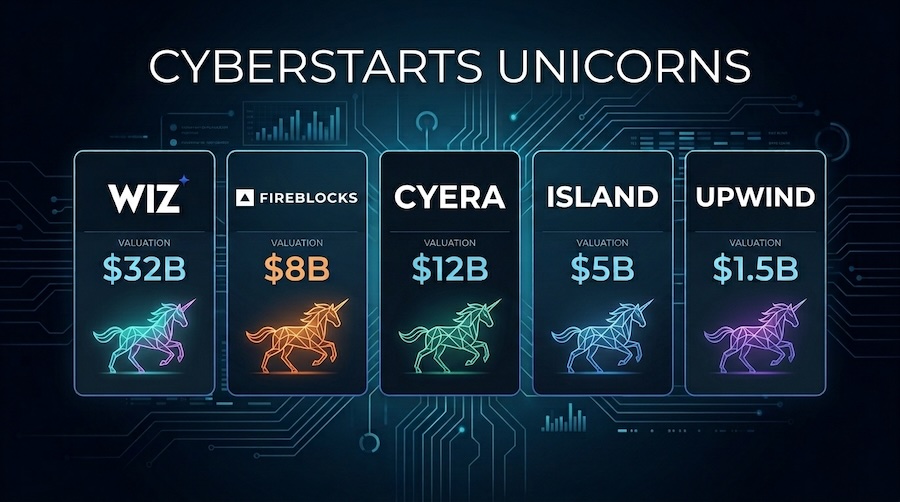
To date, the fund has recorded nine exits and grown five unicorns, two of them decacorns – including, of course, the seed investment from which a small startup called Wiz sprouted. That investment turned, within a remarkably short time, into a $32 billion all-cash deal – the largest exit in the history of Israeli tech, the largest acquisition Google has ever made, one of the largest M&A deals in the history of global tech, and the largest ever recorded for a venture-backed startup.
It’s not just the most successful investment in the history of Israeli tech – it was also one of the very first investments Raanan made under his first fund, right at the start of his journey. Out of a debut fund of just $50 million, alongside the seed investment in Wiz, he invested in eight other small startups – among them Axis Security, Fireblocks, Bionic, and Island – all of which grew into successful companies worth hundreds of millions, and in some cases billions, of dollars. By 2021, the combined value of the portfolio companies had already crossed $25 billion, propelling the fund’s own valuation past $2 billion within just three years.
“It was a cosmic event. Hitting on six or seven companies out of nine – there’s no precedent for something like that,” Raanan says. Since then, Cyberstarts has continued racking up successes. The value of the fund’s portfolio companies has climbed sharply and now stands at roughly $65 billion – a figure that, according to Raanan, represents more than half the total market value of all private cybersecurity companies in the world.
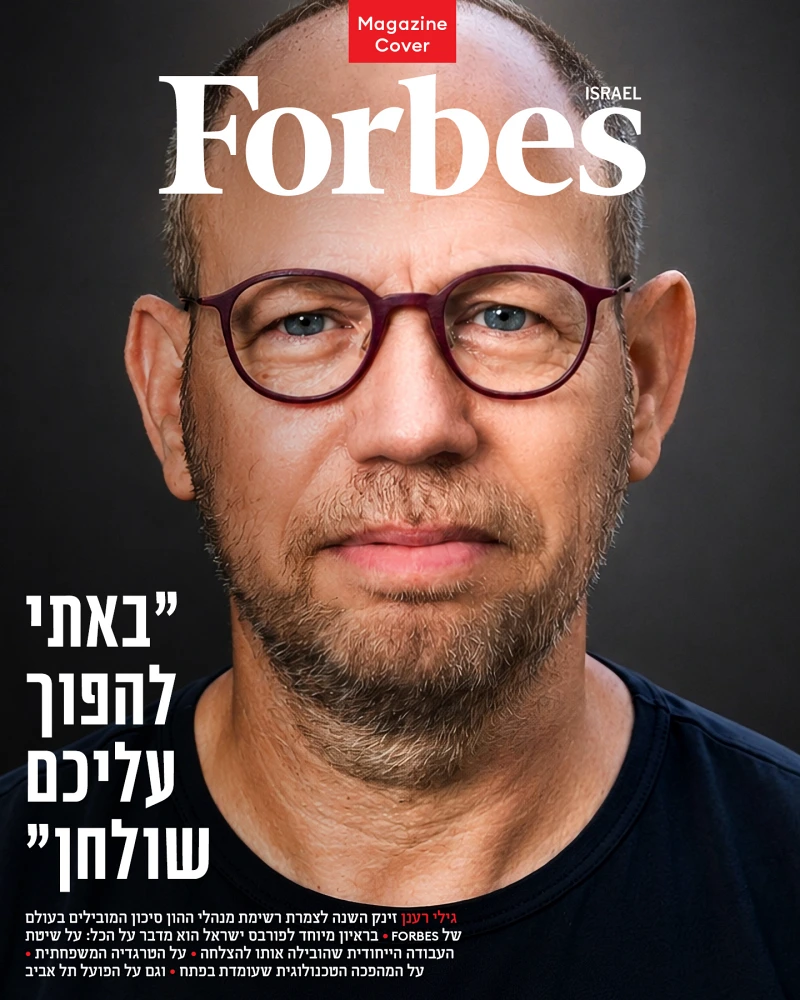
At the same time, the historic investment in Wiz, alongside other successful bets across more than 50 startups – including Armis, Cyera, Upwind, and Noname – have earned him a place on Forbes’ prestigious list of The World’s Best Venture Capital Investors – The Midas List. On this year’s list, he ranked fourth in the world, marking the second consecutive year the Israeli venture capitalist has landed on the ranking of superstar investors – this time outranking legendary names like Peter Thiel, and Michael Moritz and Doug Leone, his former partners at Sequoia.
The Sunset on Sunrise?
It’s hard to argue with the track record master chef Gili Raanan has put on the table, or with his proven ability to spot the right ingredients and turn them into gourmet, capital-rich delicacies. But even in his kitchen, many in the industry would argue, you can’t make an omelet without breaking a few eggs – or at the very least, without treading the gray line between what’s permitted and what isn’t in the industry.
In 2024, Forbes published a comprehensive investigation revealing that, as part of an advisory program called Sunrise, Cyberstarts incentivized chief information security officers (CISOs) who took part as advisors to the fund’s portfolio companies, awarding them royalties in a way that created a clear conflict of interest. According to the investigation, CISOs at major American corporations) including Freddie Mac, Kraft Heinz, Colgate-Palmolive, and Fidelity) advised startups in which Cyberstarts had invested, and in exchange received a 4% cut of the fund’s profits, with payouts that could reach as high as $250,000.
Investors, entrepreneurs, and security executives quoted in the investigation argued at the time that Sunrise represented a built-in conflict of interest, since the very executives participating in the program were typically the same executives who oversaw massive software and security budgets at their organizations. Those executives held senior positions at large enterprises, giving them the power and ability to hand out exactly the kind of major contracts that could lift early-stage startups off the ground and pave their way to success.
Following the reports, the fund eliminated the compensation component of the program. Raanan, to his credit, addresses the allegations head-on, without deflecting – and even describes Sunrise as one of the things he is most proud of. “At some point we realized there was a problem with the concept, and we made a change. Today there’s no compensation,” Raanan emphasizes.
“Today, more than 70 CISOs take part in the program. It’s operating and serving our entrepreneurs and our companies in an exceptional way,” he argues. “At the end of the day, there’s no way to build technology solutions in a lab, in an academic vacuum. You have to solve real problems for real people, and this program does exactly that – it sits precisely at the crucial intersection between entrepreneurs and technology buyers, between customers and users. It’s laser-focused on the actual pain points – what hurts, and what needs solving.”
Confronting the Demons
Either way, the results on the ground speak for themselves, and few would dispute Raanan’s gift for spotting talent, his sharpened instincts for sensing potential in people, and his highly developed emotional intelligence.
The “Gili Raanan method,” refined over the years, shifted from a search for brilliant ideas to a search for people – “not necessarily the smartest or sharpest people in the room,” he emphasizes. Mainly people in whom he identified potential wrapped inside a complex personal struggle. “I look for people who have been through some kind of trauma, some kind of major personal crisis. I don’t want people who’ve had a straight line through life – not because I’m seeking out pain, but because I need to protect myself from risk.
“At the end of the day, if you were the most successful kid in the family, king of the classroom, a talented officer in Unit 8200, the best product manager at Palo Alto Networks or Google, and after all that you started a company – and then, running that company, you hit a major crisis for the first time in your life – I don’t know how you’ll react to it,” Raanan argues. “Will you break? Will you freeze up? What will come out of you? That’s a risk I have to protect myself against.
“The way I found to protect myself from that kind of risk is to look for people who have been through a very significant personal crisis,” he continues. “People who lived through an ugly divorce up close, who lived in the closet and were ashamed of who they were, who went through severe social isolation, who grew up without a father at home because he left when they were young. And yet, despite all that hardship, they found a way to overcome it and excel. People who, despite the deep scar on their psyche, managed to find the inner strength to overcome it and prove their excellence – those are the people I’m looking for.”
Is that what you saw as well in Wiz CEO and founder Assaf Rappaport?
“That’s what I saw in everyone I’ve invested in. Amiram Shachar and Yevgeny Dibrov grew up without a father [Shachar, founder and CEO of Upwind; Dibrov, co-founder and CEO of Armis – I.Z.]. Merav Bahat [founder and CEO of Dazz, which was acquired by Wiz – I.Z.] grew up in a religious household and wasn’t allowed to study mathematics or serve in the army. Every single person I chose, or who chose me, is someone who went through something in life, someone who carries a scar.”
Would today’s Gili Raanan, the investor, have chosen the young entrepreneur Gili Raanan?
“I don’t know. It’s very hard for me to do that kind of retrospective. I grew up in the Kfar Saba of the 1980s – and yes, I felt completely isolated there from the world. I spent most of my time at the local public library, which didn’t exactly make me ‘the most popular kid in the class’. I felt like I didn’t belong at all. The first time I ever felt like I belonged was in the army, when I was accepted into the elite Talpiot program’s intelligence track.”
There, he recounts, at an especially young age – just 24 – he was handed responsibility for a massive technological project, at the time one of the largest in the country: a project worth hundreds of millions of dollars, managing hundreds of people, with zero prior management experience. “Bringing that in within two years, and afterward receiving the Israel Defense Prize, and more importantly than that – knowing that project works and saves lives – that’s an experience after which you say to yourself, okay, I’m capable of anything,” he recalls.
Years later, during the period when he was founding Cyberstarts, an immense personal tragedy struck Raanan and his family – his daughter Adi, 19, was killed. “I had just officially closed the fund’s paperwork, went on a week’s vacation abroad, and during that very week Adi was killed. We came back to a completely new world, a world of pain,” he shares. “It’s clear that Adi’s death intensified and deepened my need to look inward, and to appreciate even more the internal journey a person goes through to confront their own demons – the ability to come out the other side and turn that energy into something that pushes you forward, instead of dragging you down.”
His decision to specifically seek out people who had experienced trauma and significant personal crisis predates the enormous loss of his daughter Adi: “It wasn’t the trigger for it, but it certainly changed me and deepened my capacity to look inward. It’s the kind of event that forces you to dig into your own psyche, even in places that are extremely, extremely painful.”
The Forecast: Mass Waves of Unemployment
Today, with a long military service as an officer in Unit 8200 behind him, two startups he founded and sold in successful exits, a partnership at one of the world’s oldest and largest venture capital firms, and the founding of one of the world’s leading cybersecurity-focused investment funds – Raanan sees his work as a calling, and his activity as his life’s mission.
This past Independence Day, he was chosen to light a torch at the state ceremony held on Mount Herzl. The public committee justified its choice by naming him “one of the leading figures of the new generation of entrepreneurs, who has worked for years to advance Israeli innovation and place it at the global forefront.”
“To date, I’ve been a partner in founding, either as an entrepreneur or as the first investor, in more than 50 startups. The vast majority of them in cybersecurity. That’s a huge number,” he emphasizes. “I don’t think there’s a seed investor anywhere on the planet today who has made more investments than I have.
“I assume that over the next ten years I’ll be a partner in about 50 more startups. All Israeli. All in cyber,” Raanan declares. “This is a life’s mission. It’s already gone far beyond ‘building a successful fund’ or ‘generating exceptional returns.’ This is truly an engine for change for the State of Israel.”
So are you optimistic looking ahead? Aren’t you worried that, given all the challenges, Israel will lose its status as a cyber powerhouse?
“If that happens, it will be a catastrophic failure at the national level. And it could happen. I don’t think anyone with their eyes open can look at what’s happening here, at the processes taking place within Israeli society and in the region, and say they aren’t concerned. Ultimately, to survive in this region, we have to be a democratic, advanced, technological state that sanctifies excellence. That’s the mission, that’s the goal placed upon us. And I’m optimistic that it will happen.
“I’m optimistic about Israeli society and about our ability to meet these challenges. As a state and as a society, we’ve been through terrible years recently, we’ve paid an enormous price – but ultimately I’m optimistic, and I believe we will overcome these challenges. I have no doubt whatsoever that Israel will continue to be a global powerhouse and a global brand in cybersecurity.”
Alongside the challenges facing the country, Israeli tech is grappling with no shortage of internal challenges of its own: waves of layoffs, a strong shekel, and perhaps the greatest challenge of all – the AI revolution.
“I think the great AI revolution is still ahead of us. The moment artificial intelligence becomes excellent across a whole range of other fields, what we’re seeing today will turn into an extraordinary tsunami – and we’re approaching that at a pace we simply can’t process. These aren’t things the human brain is even capable of fully grasping. We’re watching a technological doubling unfold within our own lifetimes – something humanity has experienced before, but that took nearly 200 years, from the Industrial Revolution of the mid-19th century until today. And the pace of our technological advancement right now is such that we’ll likely experience that same doubling within the next ten years.
“No human being in history has ever experienced anything like this – a leap from using a mechanical loom to a smartphone, within a single lifetime. From working as a coal miner to being a software engineer writing code in Claude Code. We are the first living people ever to experience an event like this during our own lifetimes – and the doubling that follows will happen in an even shorter span.”
So what does the future hold for us?
“It’s very hard to predict. I’m fairly convinced we’ll see very, very large waves of unemployment in the coming years. We’re seeing early signs of that now, but we’re still ahead of the real mass impact, mainly because AI today is still a supporting tool – but soon it will replace people across an enormous range of professions and fields, and human beings will need to learn to reinvent themselves.”
“We’re watching a technological doubling unfold within our lifetimes – something humanity has already experienced, but it took nearly 200 years, from the Industrial Revolution until today. Now it will take 10 years. No person in history has experienced anything like it – a leap from using a weaving loom to a smartphone within a single lifetime. We are the first living people ever to experience an event like this.”
And where will we, here in Israel, be positioned in this revolution? Leading at the forefront?
“If we manage to remain democratic and technologically advanced, and to keep encouraging excellence – the answer is yes, with an exclamation point. But if, instead of values of progress and excellence, we become a state that promotes a different set of values, then unequivocally – no.”
Alongside the dozens of deals he’s made over nearly two decades as a venture capitalist, there’s one investment that breaks entirely from the usual pattern of his portfolio – the Hapoel Tel Aviv basketball club. In February 2025, Raanan signed an investment agreement with Ofer Yanai, the controlling shareholder of the club and of the publicly traded company Nofar Energy, under which he acquired a 10% stake in the club for 10 million shekels. This year, he increased his stake in the club, and as of today holds 20% of total shares.
Is Hapoel Tel Aviv a long-term investment, or a hobby?
“You can file that one under ‘hobby.'”
An expensive hobby.
“Very expensive.”
So how did you end up there?
“I was looking for a way to give something back to the community, something that would do people good. Over the past three years, there have been plenty of reasons not to feel happy in this country, and sports does people good.
At the same time, my son, Roi, a devoted Hapoel fan, had just finished his military service, and I remembered that when I was his age, my own father wasn’t very interested in that kind of thing. So I thought about a way to create something that would give the two of us a lot to talk about. It all came together here – the desire to do something that touches a lot of people and does good, and something that would connect me with my son – it all intersected and merged into this project.
“At the end of the day, Hapoel is a team with an underdog mentality, one that hasn’t won anything in more than 50 years. There’s Maccabi, and there’s us – and that’s something I really relate to. The underdog spirit. It’s exactly like in the cyber market – I look at the old guard, at Check Point, and I say: I Came to Change the Rules of the Game. I didn’t come to play nice.”