
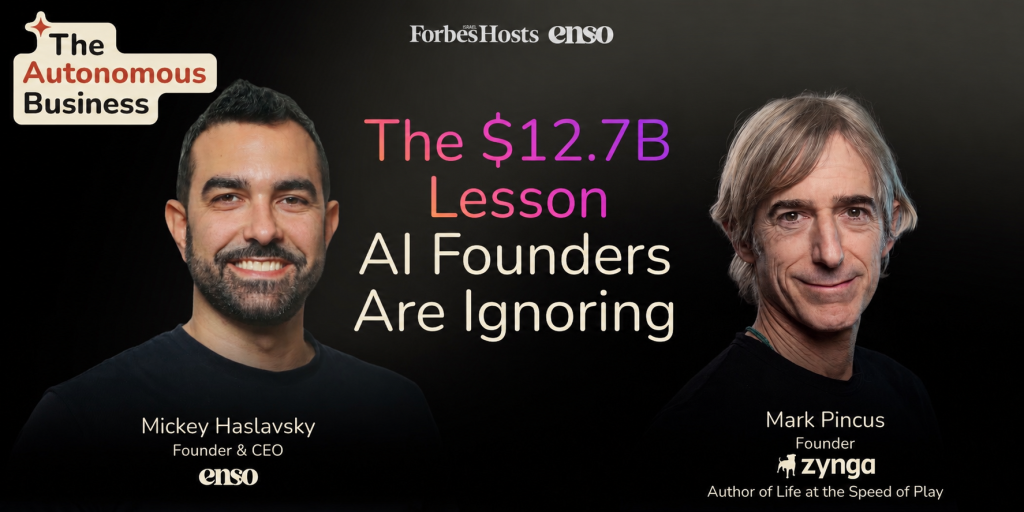
Mark Pincus has been thinking about failure machines longer than most founders have been thinking about AI. The Zynga founder, whose company went from a poker app on Facebook to a $12.7 billion acquisition by Take-Two Interactive, spent the early days of social gaming obsessed with a single idea: test more ideas in a week than your industry tests in a year. Now, sitting down with me on the Autonomous Business Podcast, he says that tools have gotten radically better, but the product discipline has gotten worse. “AI can also be a dangerous tool,” he told me. “People are even more likely to just skip testing.”
What followed was one of the most candid conversations I have had on this show. Over the course of fifty minutes, Pincus laid out his framework for product building, explained why he pulled the plug on a project he had been working on for four years, shared the two decisions he most regrets from his time running Zynga, described a thirty-two-year journaling practice that keeps him honest with himself, and made a case for why AI will make us work more, not less. The common thread through all of it: the same instincts that built the fastest web 2.0 company to IPO, and eventually be taken private for $12.7 billion are the ones most founders are ignoring right now.
The Product Mindset Behind Proven Better New
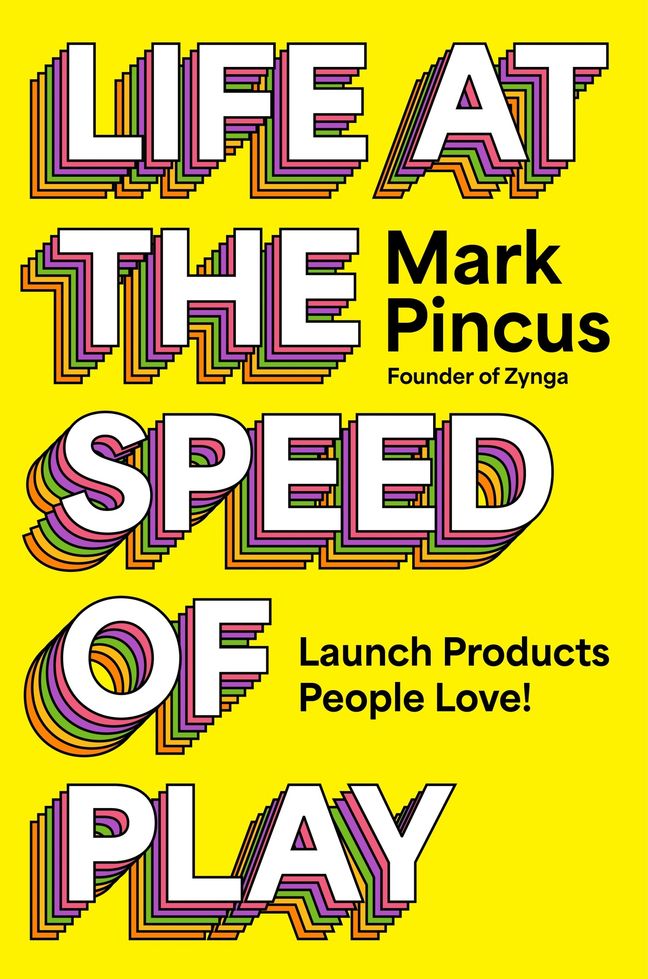
Pincus has a new book coming out on June 23, Life at the Speed of Play (Harper Collins). It was originally going to be called Proven Better New, after the framework at its center. He changed the title because he didn’t want people to treat the book as a recipe for product success. “I didn’t want to just give people a framework they could go and apply in a rote way,” he said. “I wanted to encourage people to get into a certain mindset.”
The mindset goes like this. Every founder starts with an instinct about a problem. That instinct is usually right, but the idea they build around it is usually wrong. Pincus wants founders to accept that split and act accordingly. “If we’re scientists in white lab coats and we start with this premise that the instinct is right, but the idea is probably wrong, we’re going to take a fundamentally different approach,” he explained. “It’s curious, it’s humble, and it’s killing our ego.”
He described the framework as Thielian in spirit. There is a moral arbitrage in it: instead of building to impress peers, you build to impress end users. “I don’t need to win the respect of my peers,” he said. “I need to win the hearts and clicks of my end users. Innovation is in their eyes, and it usually comes in smaller packages than most of us like to think.”
“I don’t need to win the respect of my peers. I need to win the hearts and clicks of my end users.”
In practice, Proven Better New means isolating the one thing you are actually testing and leveraging everything else from what already works (and end users are used to). Copy the onboarding flow that converts. Copy the UI patterns users already understand. Copy the pricing model that your competitors validated. Then innovate only the core insight – the one piece that makes your product different. “The part that’s not your idea zone, you’re gonna outsource that to the world that’s already invented it,” Pincus said. “We could try to make it look slightly different, if you want, but we’re not going to mess with it.”
This is where most founders fail, he argued. “It’s sad to see somebody have a really innovative idea, but it’s buried in a failing product. And it’s failing for reasons it shouldn’t have failed. You have a shitty onboard flow and a shitty first-time user experience and you failed to get your PhD in FTUEs.” (FTUE is a gaming industry shorthand for first-time user experience.) “Those have nothing to do with your product, but you don’t get to skip those.”
And the framework only works if the entire team is on it. “There’s a religion,” he said, “and everyone’s got to be on that same religion, or you’re going to be pulling in different directions.”
The MVP Trap, Accelerated
The AI era has made this problem worse, not better. Pincus described what he calls the failure machine: a system that tests massive numbers of product variants automatically. His mantra at Zynga was to test more ideas in a week than the industry tests in a year. He expected AI to make that trivially easy. It hasn’t happened.
“I would have thought by now somebody would make agents where I could just tell it an idea before I go to sleep. Invent a new travel agency. And then overnight it does all the PMing,” he said. The agent would generate hundreds of variants using Proven Better New, create ads for each one, test them across demographics using simulated audiences rather than wasting real money, and report back by morning. “It should be coming back to you in the morning like the best PM, already having done the top-of-funnel testing. And you get extra credit if your AI can even find the variant that tests well enough, and goes and builds a first prototype and tests that too.”
Nobody has built this yet, he said. Instead, he sees the opposite. “Because you can build something so quickly and you get so invested in it, people are still falling into the MVP trap. They’re still just saying, ooh, I love my idea so much. I can, if I just give it a couple more weeks using AI, I could build a whole launchable version of this idea. So they skip testing.”
The false finish line of a completed MVP is closer than ever, and it is more tempting than ever. “You can see the false finish line. It’s so much closer and so tantalizing that now you’re even more likely to just skip testing. That is exactly the point where you need to test most.”
“You can see the false finish line. It’s so much closer and so tantalizing that now you’re even more likely to just skip testing.”
When the Fish Are Running
Despite his warnings about undisciplined building, Pincus is not cautious about AI itself. He describes himself as “hugely AI maximalist” and says he is working harder than he has in years.
I asked him directly: does AI make you more productive so you work less, or does it make you more productive so you work more? “I’m working a lot more,” he said. “I’m way more active because I’m getting more leverage and productivity.”
He drew a parallel to the early Zynga days, when the feedback loop between action and result was so tight that running the company felt like playing a video game. He would send messages to his entire team at three or four in the morning on Saturday nights. When people told him he was burning them out, he started scheduling the messages for Sunday morning instead. Then, even that felt too aggressive, so he started a weekly ritual he called Sunday Morning Joy: a company-wide note highlighting what was going well and why he couldn’t wait for Monday. “I recommend founders try that,” he said.
Then came the white tiger story. One Friday evening at the Mafia Wars studio, Pincus was drinking beers with his engineers. A friend had suggested at a party a few nights earlier that Mafia Wars should add a white tiger. “She knew nothing about games, but she said, ‘I think it would go cool with the mob. They’d want a white tiger.’” Pincus asked his engineers how long another content drop would take. Four hours. He ordered food, stayed late with them, and by the end of the night it had generated another hundred thousand dollars. “I was like, I can’t afford to sleep, and I can’t afford to stop.” The following weekend, he started paying engineers $2,000 each to come in on Saturdays for additional drops that would generate hundreds of thousands more.
“That’s kind of what this moment feels like to me,” he said. “AI makes us so much more productive. And we’re like, holy shit, I can’t believe I just got that back. It just vetted my entire idea.”
He coined a phrase for it at Zynga that he says applies now: “When the fish are running, you’re up all night throwing nets.”
“When the fish are running, you’re up all night throwing nets.”
His view on token economics reinforces the point. Pincus believes intelligence will become as available as water, and the cost per token will approach zero. He credits Gary Tan for the framing. But total spending will go up, not down, because cheap productivity creates its own demand. “The amount of tokens per dollar is gonna go up exponentially, and then the amount of dollars we spend on tokens will also go up with it.”
He went further, arguing that economists are not equipped to measure what is happening. “The productivity of ideas that are passing freely isn’t measured as part of anyone’s GDP or productivity, but it really is,” he said. “It’s why I think we’ve had massive deflation going on for the last twenty years, but it’s been masked by the rate that our governments are printing more money.”
Magnify Your Best People, Kill the Middle Layer
I shifted the conversation to the people who are not on the winning side of this productivity surge: workers who are struggling to make the transition. Pincus responded with a question that surprised me. “Do you personally know any of these people? Because I don’t. I haven’t encountered anybody yet.”
He is from Chicago, still close to his Midwestern family, and says he has not met a single person who has been displaced by AI or is genuinely scared about their job. I told him I had met leaders in large organizations who were clear that a portion of their workforce would not make the leap. He stipulated the problem and moved on to solutions.
“The great news is it’s here and it’s on tap for all of us,” he said. “For free or twenty dollars a month. All you have to do is just start using it.” He recommended a specific progression: start with chat, move to a tool like Claude Cowork, then move to Claude Code to make agents and persistent skill files. “You can upload my book to Claude and make yourself a Zynga PM or a Mark Pincus PM that is doing Proven Better New for you all the time. Or take whatever your industry is and just say, I want to hire Peter Thiel, I want to hire Ethan Mollick (a leading AI academic and researcher), whoever the expert is.”
But Pincus reserved his sharpest take for enterprise adoption. He described what he sees as two phases of enterprise AI. Phase 1.0 was about bragging rights: who is using the most tokens, who has replaced the most humans, who is building as a solo founder. He even cited a story about someone at Anthropic bragging that their CFO was the company’s biggest token user. “Tokenmaxxing,” he called it.
Phase 2.0 is different. It is about magnifying your best people, not replacing your average ones. He pointed to Hivemind, a neolab he co-founded with Reid Hoffman and ML researcher Ritankar Das. “It’s much more about how do we capture the brilliance and judgment and edge-case knowledge of your best people so that we leverage them more.”
The real prize, he argued, is eliminating the middle layer: managers and supervisors whose job is to communicate up and down between the people doing the work and the people making decisions. “That’s the real exciting zone,” he said. “To figure out how to use AI to get out of the need for layers of people that have no job other than to communicate up and down and supervise.”
He described his ideal organizational structure as an inverted pyramid. Customers at the top, frontline people below them, and the founder at the bottom. “And hopefully nobody in between.”
Scaling Is Failing
One chapter in Life at the Speed of Play is titled, by Pincus’s own admission, in language too blunt for this article. The theme: scaling is a necessary evil, never an objective.
”The minute that scaling takes you away from quality and takes you away from being close to the metal as a founder, scaling is failing,” he said. He was clear about the distinction between the strategy and execution of scaling. The execution has changed with AI, but the strategy has not.
“The minute that scaling takes you away from quality and takes you away from being close to the metal as a founder, scaling is failing.”
Where this connects to AI is the temptation to use agents and automation as a substitute for founder proximity to the customer. Pincus’s test is simple: if scaling is moving you further from customers, it is failing, no matter how efficiently it runs.
The Zynga Playbook: Largest Chip Stack at the Table
When I asked Pincus about the moment he realized he was playing a different game at Zynga, he traced it back to before the company even existed. After the “abject failure” of Tribe.net, one of the first social networks before Facebook, he made a commitment. “I’m gonna be dispassionate about my products. Love them all, but be ready.”
Zynga Poker was cash-flow positive within a month. But Pincus did not see poker as the core business. He wrote “social gaming” on his wall. Within his first three months, he had a 3M sticky note with three boxes: year one, year two, year three. “By the end of year three, we’re gonna be the biggest gaming network on the internet. I wanna be the YouTube of games. We wanna make gaming a top ten behavior on the internet, which it was not.”
His approach was to have the largest chip stack at the table and massively overinvest at every juncture. Zynga was acquiring a new company every month. “I just kept injecting new entrepreneurial founder, divergent, weird DNA into the company,” he said. The hires were unconventional. “The best resume is a successful app. They went and took a risk and built something and it worked. You’re hired, or you’re acquired.”
The company was cash-flow positive from early on, kept raising money, and never spent a dollar of it because the business kept expanding. By the time Zynga went public, it had $1.4 billion in the bank. “We didn’t need to go public,” he said.
Bing Gordon, a board member and collaborator, had a rule of thumb that Pincus wishes he had followed more aggressively. Any incumbent should bet 10% of its market value every year on the next platform shift, regardless of whether it works. “If you’re an incumbent today, Bing would say you should be betting 10% of your market value every year on AI. It doesn’t matter if it works.”
Pincus’s only regret is that he did not invest more. In 2012, Zynga bought the independent flash game studio OMG Pop for $200 million. The company was worth roughly $10 to $14 billion at the time. They did not hit the 10% threshold. Says Mark: “I should have invested a billion dollars in 2012 in mobile.”
Two Decisions He Would Reverse
I asked Pincus whether there was a decision from Zynga he would make differently today. He named two without hesitating.
The first: in 2013, he replaced himself as CEO. “It was the wrong decision,” he said flatly. He was burned out. The web business was mature. [Our shift to] mobile was not working. He thought the company needed a different leader. “But when your company is in a reinvention moment, it’s probably the worst possible time. You’re in midair and you’ve got to rebuild your engines. You need the people who built it the first time.”
The hardest part was that everyone congratulated him for stepping aside. “My board, Wall Street, the stock went up. Everyone thought, great, you’re stepping aside.” But the company needed the opposite of a graceful exit. It needed its original builder.
The second: the Supercell deal. In the fall of 2012, Zynga had a handshake agreement to buy Supercell for $400 million in cash. His board refused. “The only reason we didn’t do it was our own context,” Pincus said. “We were a two-dollar stock and our OMG Pop acquisition had failed, and our board was grumpy. That’s not a reason to not do the right acquisition.”
Supercell already had Clash of Clans moving up the charts. The team was phenomenal. Zynga could afford to be wrong on $400 million. “Facebook was kind of in the same place after they went public and dropped to a twenty-dollar stock. People don’t remember. And then soon after they bought WhatsApp for $19 billion.”
His takeaway is direct. “I should have taken more of an Elon-level risk and been more willing to be unpopular with and override my board, and accept that maybe we’d go from a two-dollar stock to a one-dollar stock. I’d like to think that I would have more courage next time.”
“I should have taken more of an Elon-level risk and been more willing to be unpopular with and override my board.”
A Wartime Board for Wartime Decisions
Pincus reserved some of his strongest opinions for governance. He urged public company founders to rethink their boards the moment they go public. “Trade those VCs out. They got you to where you are. They’re going to get you to where you need to go.”
His reasoning is structural, not personal. VCs operate on ten-year fund cycles and need to show their DPI. They are not set up to bet on a company’s next decade. Professional board members optimize for legal governance, not growth. “They’re incented to not fail, not to win,” Pincus said.
Then there is the celebrity board member: the famous founder or operator whose name looks good in the press release. “They’re enticing,” Pincus said. “But at some point when things get bad, they worry about their reputations.”
What founders need are owners. Board members with real equity on the line who will go into the darkest moments. “When you look stupid, when you want to exercise your founder mode and your founder control, they’re ready for you to have a bet-the-company moment. Because you didn’t do this to then become risk-averse.”
He offered a specific framing for early-stage founders as well. At seed stage, taking big risks is structurally aligned with your investors because they have a portfolio and can afford seven out of ten to fail. At the growth stage, maybe one out of three can fail. But once you are public, “there’s zero tolerance for failure.” That is exactly when you need board members who have the stomach for it.
The Book of Life: Thirty-Two Years of Self-Accountability
One of the more personal moments in our conversation came when Pincus described his Book of Life, a journal he has kept for thirty-two years, since 1994. Every year, around the Jewish holidays, he writes down two commitments: one that is entirely within his control and one that is boldly ambitious.
The first commitment, he said, should be something he calls “elective surgery,” sometimes literally. “If there’s any elective surgery that any of your listeners are considering, that’s the easiest positive change you can make. Just bring it forward and do it.” This year, his elective surgery commitment was to address a back injury from surfing, doing the hard therapy and potentially surgery for spinal stenosis.
The boldly ambitious commitment has been the same for twenty years, his own version of “next year in Jerusalem”: launch Dot Earth, his vision of a gamified metaverse. This isn’t Zuckerberg’s goggles-immersed version…“My vision of the metaverse is that we blur the virtual and the real and the analog and the digital,” he said.
He did not launch Dot Earth this year. He’s spent the last four years building STEM Studio, a browser-based game engine in Three.js that works well with AI. This year, he pulled the plug on the commercial effort and open-sourced it. But he felt good about the outcome. “The flavor of being in integrity is not that you succeed at whatever the thing is, but that you focused on it. It’s signing up to really put the priority and focus around the things that you care about.”
Dinosaurs and the AI-Native Reset
The STEM Studio story is also a story about the most important strategic question of this era: start AI-native or die.
STEM Studio started in 2021, pre-AI, with software-first architecture. AI was the last layer, not the first. Meanwhile, AI-native startups like Rosebud and Spawn were doing prompt-to-game. Pincus and his team initially dismissed them. “We scoffed at them in the beginning, like the dinosaurs,” he admitted. “They made shitty games. And they got better and better and better.”
Those startups started on the AI side of the river and were building toward the functionality STEM Studio already had. But they had a structural advantage: they appealed to everyone from day one, while STEM Studio required technical users. “Where the other one appeals to everyone out of the box, which is more appealing,” Pincus said. “And you’re gonna get more testing on theirs.” More users means more iterations. More iterations means faster convergence on quality. The prompt-to-game companies were compounding faster because they were compounding from a larger base.
Pincus’s conclusion extends well beyond gaming. “I think that everybody needs to do a reset and start in an AI-native place,” he said. “I’m not a believer in these SaaS software companies just tacking AI onto what they’re doing. They’ll probably buy AI-native companies and end up just becoming those and killing their legacy products.”
“We scoffed at them in the beginning, like the dinosaurs. They made shitty games. And they got better and better and better.”
Start on the AI Side of the River
The through-line of Pincus’s argument is consistency. The same discipline that made Zynga work (test fast, copy what’s proven, innovate only the core) applies to building with AI. But the starting point has to change. Legacy tools, legacy architectures, legacy assumptions about what a team looks like: all of it needs a reset.
The founders who will win are the ones who start on the AI side of the river and build from there. Not the ones who built something five years ago and are now trying to bolt AI onto it.
“When the fish are running,” Pincus told me, “you’re up all night throwing nets.” The fish are running. The question is whether you are building nets or still arguing about which boat to take.
Mickey Haslavsky is the Founder and CEO of enso and a Forbes 30 Under 30 alumnus. He previously founded Rapid (acquired by Nokia) and hosts The Autonomous Business Podcast, in partnership with Forbes Israel.