
The music industry has a number it has stopped enjoying. In 2025, an average of 106,000 new tracks arrived on streaming services every day, and the total catalog sitting on those services passed 253 million, according to Luminate’s year-end report. Deezer, the only major platform that systematically labels machine-made music, said in April that 44 percent of its daily uploads were fully AI-generated. By July that figure had crossed half. Those tracks capture around three percent of actual listening time.
So the flood is real, and almost nobody can hear it coming.
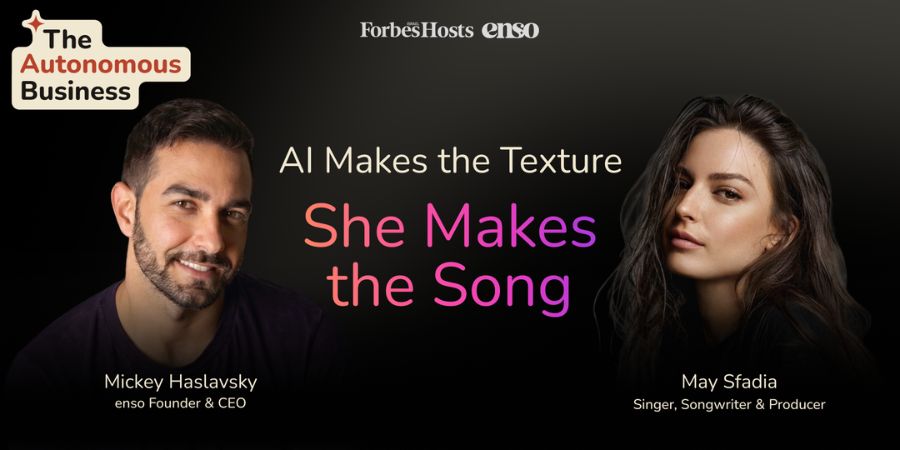
May Sfadia can. “I can identify within three seconds whether it is Suno or not Suno, by the sound, because I know how it sounds,” she told me on the Autonomous Podcast. Then she explained why, and it was not the reason I expected. “I know Suno’s sound also because I work with it.”
Sfadia sings, writes, composes and produces, which in Israeli pop is an unusual stack to find inside one person. She is a co-writer on “Unicorn,” the Noa Kirel single that finished third at the 2023 Eurovision Song Contest with 362 points, and a co-writer and co-composer on Ran Danker’s “My New Dress,” one of the biggest Hebrew hits of the decade. She learned Ableton Live from YouTube, at a desk pushed up against her bed in her parents’ apartment in Haifa, because she didn’t want to depend on anyone.
What followed over the next hour was the least theoretical conversation about AI I have had on this show. Sfadia opened her session, composed a song in front of me, ran it through Suno twice, explained exactly what she was listening for, and then drew a line she said she is not currently willing to cross. The line is not where most people assume it is.
The Last Song She Paid For
Most arguments about AI and creative work are arguments about cost, and they are usually conducted by people who have never paid the bill. Sfadia has. She broke the economics down on air, with numbers, because it is the part of her story that explains everything after it.
A single Hebrew-language release, done properly, starts with music production, which she put at around 15,000 shekels. Then a publicist, which is a few thousand more. Then a music video, then social content, then paid campaigns, then a press shoot. “It really has no end,” she said. By her account the full bill lands near 30,000 shekels, and this is where most young artists stop, because they do not know where that investment is supposed to come from.
She reached that wall early. She had one song she believed in completely, and she put everything she had on it. She hired the publicist. She did every step the way it is supposed to be done.
“And nothing happened with it. Really, really nothing.”
What she did next is the hinge of her career, and she described it almost apologetically. With the money that was left, she stopped buying promotion and bought studio equipment instead. The plan was modest and, in her own word, naive: record her own piano and vocal sketches, put a few clips on Instagram, send material out, maybe get signed by somebody.
Then she locked herself in the room. “I really closed myself in the room from morning until night to learn it.” Within roughly a week of pressing every button in the software, the plan stopped being about sketches. “I understood that I could actually do this alone.”
She set herself a rule that reads like a training regimen, because it was one. Every day, before midnight, one finished song: lyrics, melody and production. Not to release. To build the muscle and to learn the tool.
I pushed back on the romance of this, because the bedroom-studio story is common and the outcome is not. Plenty of people buy an interface, clear a desk at their parents’ place and call it a studio. Very few of them end up writing “Unicorn.”
Her answer was that the next song she released cost nothing at all. No budget, no publicist, nothing she had spent money on the first time. It was also, she said, strange and a little unhinged, “because there were no rules there as far as I was concerned.” That is the one that worked. The industry started calling. Ran Danker, who was between chapters in his own career and looking for something weirder, heard it, drove to Haifa, and sat down with her for what was the first session she had ever done with another artist. She had no idea what writing for somebody else was supposed to involve. “I said yes, and afterwards we will think and understand.”
That session produced “My New Dress.” The hit opened the door to the session requests, and the session requests led to “Unicorn.”
The thing that changed her career was not a budget. It was a capability. That distinction is the whole reason she is worth asking about AI at all, because the current generation of tools is making the same promise to a much larger number of people, and she is one of the few who has already lived through what happens on the other side of it.
A Collection of Things That Already Existed
Ask Sfadia what generative music is and she does not reach for a position. She reaches for a description.
“I think that AI creation is some collection of things that already existed,” she said. “In my view AI does not invent something new. It takes, it makes some kind of mash and creates something that can be excellent.”
She is careful with that last clause, and she repeats it. She is not claiming the output is bad. She said flatly that there are already AI pop hits sitting at the top of the charts worldwide, which is correct: an AI country act called Breaking Rust reached number one on Billboard’s country digital song sales chart last November, and before that an AI R&B project called Xania Monet signed with Hallwood Media for a reported three million dollars. Her claim is narrower and harder to dismiss. “There is something in the soul of a human being that I believe AI cannot, and will not be able to.”
What interests her is where the ceiling actually sits. “It is very, very interesting to me what level the AI will reach,” she said, and the thing she wants to know is whether a machine can reach the level of a person “who writes now really from the soul, at night, after something.” Then she gave the compressed version. “In the end it is truth that speaks outward.”
This is where I tried a number on her and she did not take it. I put it to her that Spotify was absorbing something like 200,000 new songs a day, roughly 70 percent of them AI. She said she thought it was lower, closer to 70,000 or 80,000, and I had to admit I did not have a precise figure. The verified numbers sit between us: Luminate’s 106,000 a day across all services, Deezer’s majority-AI upload share. Neither of us was right. Both of us were describing the same problem.
Her answer to that problem was not a strategy. It was closer to a shrug with a spine in it. “It will always be doing one more thing and one more thing and one more song. In the end there is no competition for releasing a song and the audience simply connecting to it, because they identify with it, because they lived that story.”
Low in the Mix
Then she showed me what she actually does with the tool, and the abstraction collapsed into a single production decision.
On her most recent single, “The Last Dance,” Sfadia wanted to put classical strings against electronic production. She played the orchestral part herself and anchored it in MIDI. She wanted it thicker. Rather than book a string quartet, she asked Suno to take the exact part she had written and perform it as an orchestra, specifying, as she always does, the best players in the world. “I always write it that way,” she said, “so that they will not be mediocre now.”
What she did with the result is the part worth paying attention to. She did not replace her own take with it. She took the returned channel, which was her part with another layer on top of it, and she placed it low in the mix. It added volume and a particular depth she had been looking for. It saved her a recording session she did not want to pay for or schedule. And unless she tells you it is there, you do not hear it as a separate thing.
She gave a second example in the same register. If a track needs the sound of a stadium crowd, she is not going to put two hundred people in a stadium. She writes a prompt. “More accurately,” she added, “the chat writes the prompt for me.”
Both uses share a shape. The machine is never holding the melody, the lyric or the decision. It is doing the thing that used to require a budget, a booking or twenty people in a room, and it is sitting underneath something she made.
This is the part of the technology story that almost never gets reported, because it is not dramatic. At enso we spend most of our time on exactly this boundary in other industries, mapping which parts of a workflow a system can carry and which parts collapse the moment a human stops signing off on them. Sfadia had the boundary drawn in a session file. Low in the mix is not a compromise. It is a job description.
Where She Stops
I asked her to produce something live, and she did. She took a word I had used in conversation, found a harmony, recorded the piano, quantized it, recorded the vocal, added autotune and fades, and inside a few minutes there was a sketch of a song that had not existed when we started.
She wrote the lyric herself, and she stopped to say why.
“I usually do not write with AI at the moment. I do not like to write with AI. Maybe in the future that will change.”
Earlier she had explained the reason more bluntly: it is far from the soul. It is a striking place to draw the line, because it is the exact inverse of the most commercially successful AI music project of the last year. Telisha Jones, the woman behind Xania Monet, writes the lyrics herself and lets the model produce the music and the voice. Sfadia does the opposite. She hands over texture and keeps authorship.
We then ran her sketch through Suno twice, with prompts I wrote. The first was cinematic and folkish, inspired by Hans Zimmer. The result came back close enough to what she had already built that she rejected it on the spot, not because it was bad but because it was redundant. “It did something very similar to what I did, and I would want it to be more contrasting.” The second prompt went hard the other way, Bruno Mars by way of a seventies hip-hop beat, and the model declined to use the artist’s name but produced something genuinely different. That one she kept listening to.
What she was doing in both cases was not asking the tool for a song. She was asking it for a distance from her own instinct, and then judging whether the distance was useful. That is taste, applied at speed, and nothing in the prompt box supplied it.
My own thesis about why music is the field to watch is unglamorous. Most music in the world is already virtual rather than live. MIDI is programming, a DAW is software, digital sound is software, which means a model that gets better at code gets better at music, and the ceiling on that improvement is not obvious. Sfadia did not argue. She extended it into the one question she actually cares about: at what point does the sound become good enough to stand next to the work of very large producers.
She was equally undramatic about the rights question hanging over all of this. Suno settled with Warner Music Group last November and announced a framework in which artists can opt in to the use of their names, images, likenesses, voices and compositions. I raised the obvious worry about what happens to an artist’s voice once it is inside that system. “Yes,” she said. “That is also something that has been happening for a very long time already.”
The Empty Canvas
I spent most of the hour trying to get a model out of her. A structure, a method, a repeatable approach to production I could hand to somebody else. She refused, pleasantly, every time.
Production, for her, is an empty canvas. When she hears a song stripped to lyrics and melody, she can already hear the arrangement she wants in her head, and so she works almost entirely on instinct. “I also simply do not think much. I just do.” Asked whether she has a signature style, she said she does not, and that the question misunderstands where a signature lives. It is not in the genre. It is in the voice and in what the person brings. Dudu Tassa can release something fully electronic and then something stripped bare, and both are unmistakably Dudu Tassa. “The signature is everything. It is the character, in my view.”
Asked how a young producer should find inspiration in a world this loud, she apologized in advance for sounding sentimental and said it anyway: intuition. A person connected to theirs does not need to ask anyone, and can hear a hundred songs and still know where the heart leans. Asked what keeps an artist in the room for twenty or thirty years, which she notes is now very rare, she went to the same place. People do not fall in love only with the music. They want to see the person on stage, to feel them, to understand what they are going through.
So I did not get a structure. I got something more useful. Sfadia is not holding the line against the machines, she is working with one every week, and she has already decided where it belongs. Underneath the part she played. Behind the part she sang. Low in the mix, where it adds depth to a decision somebody made, and never where the decision gets made.
Mickey Haslavsky is the Founder and CEO of enso and a Forbes 30 Under 30 alumnus. He previously founded Rapid (acquired by Nokia) and hosts The Autonomous Podcast, in partnership with Forbes Israel.