A few weeks ago I picked up an infection in my hand while travelling on the East Coast and walked into an urgent care center in Boston. The care was excellent. They cleaned it, wrapped it, and had me out in thirty minutes. Then I contacted my insurance company over chat, and they sent me a document the size of the Empire State Building. Hundreds of questions about a thirty-minute visit. The bill was $250.
I did not fill it in. I paid it myself and let it go, and then I sat there wondering why I would ever buy from that company again, knowing what happens the one time I need them.
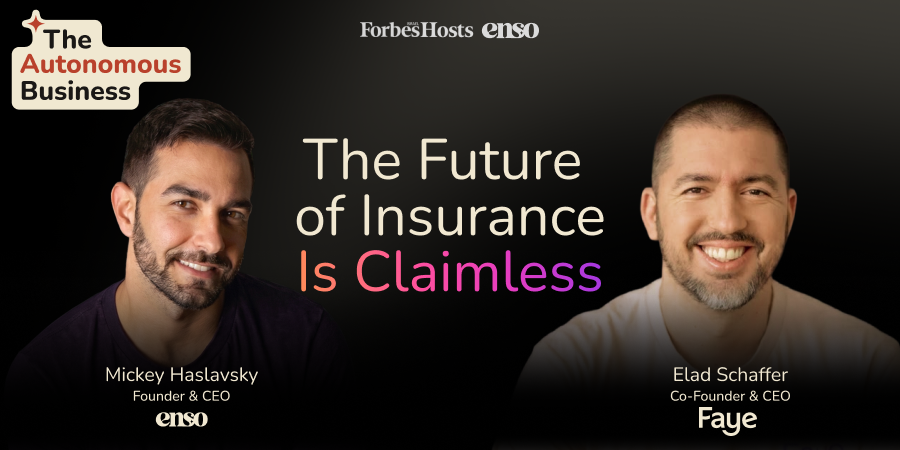
That experience is the entire business case for Faye, which is why I put it to Elad Schaffer, its co-founder and CEO, when he sat down with me on the Autonomous Business Podcast. Faye crossed $100 million in revenue in 2025, less than three years after launching in the United States, and on August 5th, three weeks after we recorded this podcast episode mid-July, it raised a $50 million Series C led by Madrona (one of the first investors in a company you may have heard of – Amazon) at a reported valuation of around $500 million. Schaffer’s answer to my abandoned claim was not that his company would have made the form shorter. It was that within a few years nobody will be filling in the form at all, and that the delay I caused by walking away is the delay that costs insurers most.
Selling Trust, Not Software
Start with what he thinks the product actually is, because it is not what the category name suggests.
“Insurance is selling trust,” he said. “We sell you a promise that if something happens, we will make you whole.” That can mean money, reimbursing losses. It can also mean fixing the problem itself. What it does not mean is a piece of software. “We’re not selling software per se. Technology is an enabler to do it faster, better.”
By that standard, travel insurance has been failing its own definition for decades. Schaffer calls it one of the most outdated industries there is, and the description he gives of the incumbent experience is close to a period piece. Lengthy claim forms. Receipts. Waiting weeks, sometimes months. “And then when you’re back home in New York after your trip, you might get a check in the mail, like in the eighties.”
The first thing AI changes, in his account, is the clock. Full automation of claims, resolved in seconds or minutes rather than weeks, compensation paid instantly into digital means (like your phone’s wallet) rather than posted as a cheque. Faye today automates between 30 and 40 percent of claims and has said it expects to pass half by the end of this year, with three quarters of what remains resolved on first contact. Schaffer’s own ceiling is considerably higher. He believes 90 percent of claims can eventually be automated to the point of paying out in seconds.
But he treats all of that as stage one, and the second stage is the interesting one. “We also argue that oftentimes when we’re traveling, what you need is a solution, not just money.”
His example is a missed connection in Berlin on the way back to the United States. The old product reimburses the unplanned hotel night and the incidentals, eventually. The one he is describing detects the missed connection before you have reported it, pays the compensation immediately, and then does the thing you actually wanted. “Because guess what? We know how many seats are available on the next flight. We know your status with, say, Lufthansa, and we’re now able to rebook you.”
Three separate agentic operations sit behind that: noticing the disruption, finding a solution, and executing it. “If insurance started as, we can reimburse you as quickly and as delightfully as we can, what AI enables you is to actually help you solve your problem.”
No Flights, Only Masks
The company that thinks this way did not set out to be an insurer at all, and the reason it became one is the best part of its history.
Faye began in 2019 as Zenner, an AI travel assistant with a product called Zenny that watched your flight, your airport and your destination and tried to predict a delay or cancellation before the airline told you. “Little did we know how AI would change our lives as it does today,” Schaffer said. The plan was information first, then help. It worked. He says they signed up a few dozen companies who wanted it for their business travelers.
Then, within months of launching a travel company, the world stopped flying. “COVID hit, and no flights, only masks.”
He is funny about what that must have looked like from the outside. “I believe our early investors were probably thinking, what did we do? Why did we give money to those guys building in travel?” There was, in his words, some serious grinding. They spent the early period assuming it would pass in two months and the original idea would be a phenomenal success, and then spent a long time coming to terms with the fact that it would not.
What saved the company was that it already had customers moving around the world, and those customers started saying something the founders had not built for. “Well, that’s nice that you told me about this flight delay, but I’m now hospitalized in Italy. What do I do? How do I access care? How do I get back home? Can you help me evacuate?”
That is the moment insurance stopped looking like an adjacent product and started looking like the core one. “That’s where the core understanding of insurance as this must-have product started to really get into our heads.” By his count it took about fourteen months to turn a travel assistant on steroids into an insurance company with 24/7 assistance, financial services and information layered on top. Faye launched in the United States in 2022.
The Claim You Did Not File
Which brings us back to my hand, and to the $250 I decided was not worth the paperwork.
In the version Schaffer describes with Faye, the sequence I went through does not exist. You answer a couple of questions. A model triages whether the symptoms you are reporting are covered, tells you they are, and shows you the doctors near you and when they are free. Better still, you see one over telemedicine. Then the part that matters. “Instantly you wouldn’t even need to file a claim. Everything is done behind the scenes within our systems.”
He has a word for this and it is a good one. Claimless. “Everything is able to be done A to Z in a claimless way.” No payment by you, no form, no receipts, no waiting.
The flight version works the same way in reverse. Faye connects to data on essentially every plane, which means it can often see that your flight is cancelled before the airline tells you, check that your policy entitles you to instant compensation, and pay it before you have asked. “Hey, Mickey, your flight has been canceled. Here’s instant compensation of $500 you might be entitled to. If you have incurred additional expenses, please send them here. Now let’s help you recover from that cancellation and get you back to your trip.”
Underneath the mechanics is an observation about people that explains why any of this matters. Competence does not travel well. “You might be the most sophisticated developer or product manager or whatever you might do in high tech. But when you’re abroad and don’t speak the local language, you may not know the local services, things can get very, very tricky, stressful, and sometimes very expensive.” Then the line that stayed with me. “Even the savviest of travelers can sometimes behave like they’re a five-year-old.”
The Policy Was Always a Commodity
I put the argument to him that most people in insurance are worried about. If an AI agent can compare thousands of policies instantly, on price and coverage, does insurance become a pure commodity?
He declined the premise on the grounds that the race is already over. “Insurance as an insurance product is already fairly commoditized,” he said. In travel insurance specifically, anyone can take an existing product, copy it, file it again with the regulator, and hold a piece of paper as good as anyone else’s. Agents comparing policies do not commoditize the category. They just make visible something that has been true the whole time.
“I think the differentiating factor is what you do with that insurance policy.” Meaning: how fast you handle claims, how fast you answer, and whether you anticipate the problem or wait for the customer to report it. “Or are you reactive? You wait for a claim to be filed and then you wait and wait and wait and perhaps you pay the customer.”
Then he pushes the argument one step further, into the part that explains why Faye’s Series C describes it as an autonomous platform for traveler care rather than an insurance company. Even a perfect insurance experience only fires when there is a claim, and by his estimate you need one perhaps 10 percent of the time. The rest of the trip is where the stress lives. “An issue that may not necessarily result in a financial loss, but it might be a very stressful situation.” A delay with an uncertain outcome. An adventure you paid for and missed. A lost passport.
“These are also areas of stress where insurance that is supposed to give that peace of mind doesn’t really deliver on today.” The product he wants is one that reissues the passport, rebooks the flight and stays with you through the bad afternoon. Almost all of which, he says, can be done agentically.
The Customer Is the Bottleneck
The most counterintuitive thing he said came when I asked what happens when everybody has a personal AI assistant that knows their travel habits, their credit cards, their health and their step count, and whether Faye would rather deal with that agent or with me.
He did not hesitate, and he went straight back to my abandoned claim. “You could have filed that claim, but you didn’t want to, because you were faced with those lengthy forms. And you said, why bother?” His point is that the question stops mattering the moment somebody else can do the bothering. “I think that question is becoming irrelevant if you could ask your AI assistant to file that claim on your behalf. And they could be the ones engaging with the insurance provider. They can be the ones who are responding, waiting, perhaps experiencing that frustration that otherwise you might experience as a customer.”
He expects it, and soon. “One hundred percent, I believe that in the future, which is not so far away, you’ll be able to tell your AI assistant, hey, file this claim for me. All the information is already in my inbox, on my drive, wherever that might be. If you need anything else, just ask me, but you now go and deal with the insurance companies.”
Most insurers would treat that prospect as a threat, another intermediary between them and the customer. Schaffer wants it, and his reason is the one genuinely surprising fact in the conversation. The thing slowing claims down is not the insurer. It is the claimant.
“One of the main reasons that customers’ claims are not solved in time is because we’re waiting on the customer,” he said. Faye asks for a document, and the customer has to go find the receipt, or the police report, or whatever it is, and that takes days. “More often than not, because we have really fantastic SLAs, we’re actually waiting on the customer to get back to us. If we could work with the customer’s AI assistant, I believe that’s for the better of everyone.”
AI for Growth, Not Efficiency
Since this is his second company, I asked how the job of the founder has changed.
His first answer was to admit the confusion rather than perform mastery of it. “I think we need to be honest with ourselves and say that there’s a lot that we don’t know. And there’s a lot of FOMO out there.” Every week brings a new model, and it is hard to keep up. “So I think first it’s about admitting that it’s hard.”
Where he lands after that is unusual for a chief executive, because it involves giving up the steering wheel. Every company has to become AI native, he says, and the only real question is how you induce it. “Frankly, I don’t believe that it has to come from the top, because top down is almost like forcing the company to do something.” The people who will actually find the uses are the hungry ones, often the younger ones, who care about the technology and bring their ideas up. “If it’s coming from the ground up, then it’s a lot healthier.” The founder’s job is to resource that and to decide where the largest bets go.
And this is the distinction he thinks most of his peers are getting wrong. “Oftentimes CEOs tend to think of the impact of AI in efficiency. Well, we may not need to hire this many folks.” He does not dispute the savings or the margin expansion. He thinks they are the small prize. “What’s more interesting is how can you leverage AI to do more, to grow faster, to build new products faster. So in other words, AI for growth as opposed to AI just for efficiency.”
He includes himself among those who got the emphasis wrong at first. “Initially, it was just about efficiency, but now we’re pivoting a lot of that thought as to how can AI enable us to grow this much faster.”
It changes who he hires, too. The old model was to hire a professional in their field. “Now you want people who are a lot more builders in their nature,” he said. “When you and I started our first companies you had someone for marketing and someone for product and someone for R&D. I think those lines are blurry.” And the bar for speed has moved with it. “If you’re doubling your sales year over year, that’s just not good enough.”
Where the Human Stays
For a conversation about automating an industry, the sharpest thing in it is his account of where the automation stops.
Two places, and the second one is not about regulation. The first is: if Faye is going to deny a claim, a person reviews it, which is also how the company operates today, automating approvals while routing rejections to humans. The second is in an emergency. “If you now need to be hospitalized, Mickey, I believe you might want to speak to an actual human. If it’s an emergency, if you need to be evacuated from a place of danger, we want a human involved.” Not only because he thinks it is the responsible thing, but because it is what people expect at the moment they are most frightened. His framing of the automation is therefore the opposite of the usual one. It exists to free adjusters and support staff to be present for the cases where presence is the product.
Which is the argument he opened with, arriving at its logical end. If insurance is selling trust rather than software, then the machine’s job is to clear away everything that is not trust, the forms, the receipts, the waiting, the check in the mail, until only the part that requires a human is left. Faye holds around 250 licences to do this in the United States, and a new insurance product can take one to two years to file across fifty states, so nothing here escapes the regulated frame it operates in.
The test is simple enough, and I ran it myself in Boston without meaning to. A promise you decline to collect on was never really a promise.
Elad Schaffer is the Co-Founder and CEO of Faye, an award-winning travel insurance and traveler care platform.
Mickey Haslavsky is the Founder and CEO of enso and a Forbes 30 Under 30 alumnus. He previously founded Rapid (acquired by Nokia) and hosts The Autonomous Business Podcast, in partnership with Forbes Israel.