
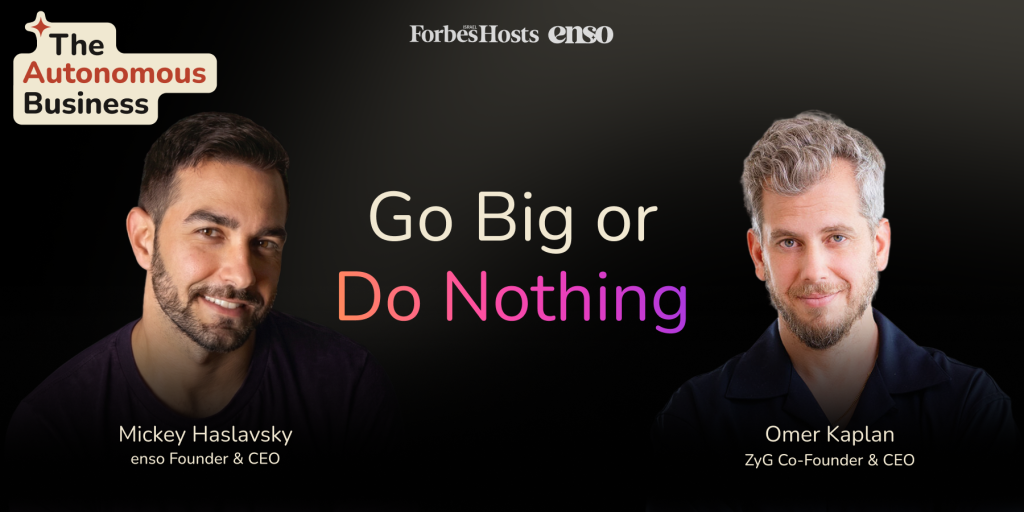
Omer Kaplan has already had the exit that most founders spend a career failing to get. He co-founded ironSource, ran its revenue for more than a decade, and watched the company list on the New York Stock Exchange in June 2021 at an $11 billion valuation. Unity bought the business the following year. In January 2024, Kaplan and the rest of the founding group walked away. He is now back at the very beginning, and the obvious question about a founder in that position is whether he is afraid of the second album syndrome.
He is not. “The short answer is I am not afraid at all,” he told me on the Autonomous Business Podcast. What he described instead was the opposite anxiety, the one that would have come from sitting this out. “I would have this insane FOMO if I wasn’t an entrepreneur right now,” he said, and he located the feeling physically, in his arteries and his veins, if he had to watch from the sidelines while everything that is now buildable got built by other people. “If you’re a builder, you have to be a part of it.”
What followed was forty minutes on a bet that runs against the loudest idea in AI. Kaplan laid out why he believes e-commerce is missing an entire category of company, explained the scoring machine his team built to decide which consumer brands deserve to be scaled, argued that a narrow point solution can no longer defend itself, and reversed a prediction he had made about his own company. He started ZyG believing AI would let him build something enormous with ten people. He now has around ninety, and he is hiring as fast as he can find outstanding engineers.
The Publisher Nobody Built
ZyG came out of stealth in March 2026 and has raised $118 million since: a $58 million seed co-led by Bessemer, Viola and Lightspeed, then a $60 million Series A led by Accel at a $500 million valuation. Eight founders, five of them out of ironSource, including its co-founder and chief executive Tomer Bar-Zeev, now ZyG’s chairman. The company describes itself as an agentic operating system for e-commerce scale.
Strip the category language away and Kaplan is describing something older than software. He is describing a publisher.
His argument starts with how a good consumer brand can actually try to achieve scale today. “They can go to Amazon and maybe they’ll get some distribution,” he said. “They can go to Shopify and they’ll get the pipes. But nobody is telling them, if you have a great product, we have scale and we’ll deliver it for you, including everything you need around it.” The gap he is pointing at is not a missing tool. It is a missing player, one that can deliver an outcome.
Tens of thousands of companies are selling a few million dollars a year with real retention and no route to a hundred million. Amazon will rent them demand without letting them own a customer. Shopify will sell them plumbing. Neither will take responsibility for the outcome. “Nobody is either crazy enough or smart enough, I don’t know, to tell them we’ll do everything.”
Kaplan and I both came out of music, and when I offered him the structure of that business, a product, a talent, and someone who connects the two to an audience, he supplied the missing word himself. “It blew my mind that in the largest TAM possible, which is e-commerce, there’s nobody who we would traditionally call a publisher,” he said. “There’s nobody that can identify talent.”
Then he named the failure mode the analogy predicts, and it is an indictment of the industry he is entering rather than a pitch for it. The best songs and the best creative work get overshadowed, he said, by whatever is attached to the better performance marketing machine. The same thing happens to products. Quality is not what gets distributed. Spend is. Closing that gap is the business he is describing.
He has run this play before. Supersonic, ironSource’s mobile game publishing arm, took games from developers anywhere, tested each one on two numbers, cost per install on Meta and day-one retention, scored it, and pushed the ones that cleared the bar. It passed two billion downloads in its first two years. Developers with no distribution of their own got scale in exchange for a share of revenue, and Kaplan mentions almost in passing that some of them were people working an oil rig in Turkey who became multimillionaires. He is proposing the same trade now for things people put in their bodies and on their shelves, with one change to the terms that he treats as the whole point.
Nothing Is Gut
First I asked him the rude version of the obvious question. If you are promising to be a brand’s growth partner rather than its software vendor, and that means real attention per customer, how is any of this scalable?
He removed the constraint. “The right question is not how this is scalable, it’s more like how would you be able to choose from the hundreds of thousands of companies that will want to work with you,” he said. Capacity is not what worries him. Selection is.
So I put the two available answers to him. Either you spray and pray across hundreds of brands after some filtering and let the market sort them, or you pick, and if you pick, you pick on gut, formulas or science. He allowed that the first is a real strategy. On the second he was categorical.
“Nothing is gut,” he said. “It’s data, it’s models, it’s prediction, and that’s why the cycle is long.”
The cycle is a sequence of gates, each designed to convert a judgment call into a measurement. Before anything gets built, ZyG agents assemble a market research report on the category and the competition. If the opportunity is strong, the team builds a full brand on its own infrastructure rather than on Amazon, creative included. That took several days when they started and now takes hours.
Then real traffic, and Kaplan was emphatic about the word real. “It’s not a synthetic audience,” he said. A few thousand dollars of spend against an internal taxonomy of channel benchmarks produces a predicted customer acquisition cost. Clear that, and the brand moves to a soft launch lasting a few months, until enough renewals exist to build a predicted lifetime value model. Only then does ZyG decide whether to go all in.
His example: a scientist with a formula originally developed for immune support, who discovered from user feedback that it thickened hair and slowed loss. He was selling a few hundred thousand dollars a year on Amazon, in what Kaplan calls one of the most competitive categories in direct-to-consumer. ZyG rebuilt the brand around the formula’s specific claim. Kaplan says the product is now doing twelve times its previous Amazon revenue, two or three months in.
This is also his answer on luck, which I raised because every publisher model in history has run on it. He does not claim to have removed it. “We will fail from time to time,” he said. What he claims is a different distribution of outcomes, on the argument that most consumer companies burn their luck in the phase where nobody is measuring carefully.
A Moat Can Be a Delivery Vehicle
The screening machine only matters if it can recognize an advantage before that advantage has proven itself. So I asked what a brand’s moat looks like from inside his funnel, and he answered with a company he does not work with.
Grüns entered the daily greens category against AG1 and against celebrity-backed entrants like IM8, where David Beckham is a co-founding partner. Its insight was not chemical. It was that nobody enjoys the product. “It’s not fun to drink this greenish, grass-feeling kind of a drink,” Kaplan said. Gummies are more enjoyable but individually cannot hold enough active ingredient, so Grüns built a daily sachet of them that a customer carries in a pocket. Unilever announced its acquisition in April 2026 at a price Axios reported as $1.2 billion, less than three years after launch.
Kaplan’s reading of it is the part that generalizes. “A moat can be many things, it’s not necessarily science,” he said. “This is a marketing moat. They invented the delivery vehicle.” And his claim about his own machine is that this was legible early. “We can identify if that’s a moat almost from day one.”
He is careful about one limit, and he volunteered it without being asked. The machine cannot manufacture the underlying product. “You can have the best marketing machine in the world. If you want a scalable business, the product needs to be great also.”
Who Owns the IP
The business model is where Kaplan’s music instincts and his mobile games experience pull against each other, and where he has deliberately broken with his own past.
In mobile game publishing, the publisher counts the revenue and pays the developer a share of profit. That structure has an unhappy history in every creative industry that has used it, and he named it himself. “There are so many cases where artists became huge, but the publisher took all their money. We all know about that.”
ZyG inverted the terms. The company takes a percentage of top-line revenue, and the partner keeps the intellectual property and recognizes the revenue. “Everything is theirs,” he said. “We’re the platform. But we are adding to the platform the services layer.” Which produces the comparison the company is plainly built toward. “Think about how big Shopify would be if they would also offer services. That’s how big I hope and believe that we’re going to be.”
The economics rest on a claim he attributed to the industry rather than to himself, the thesis everybody is speaking about today, as he put it: companies are used to paying much more for services than for software. Whatever the multiple, the operative number for a consumer brand is smaller and better established. Agency fees of ten to fifteen percent are what those brands already expect to pay, and at that rate the offer still undercuts building the function in house. “Even if you’re taking that, it’s still much cheaper than doing it internally,” he said. “And obviously, if I’m selling software, then I can take a fraction of what I said.”
I pitched Sequoia on a version of this thesis when I started enso, that automating services for smaller businesses was one of the largest addressable markets in history, back when the word service was close to a curse in tech. Kaplan’s own ambition sits in the same place, one layer up: the third platform after Amazon and Shopify.
The Point Solution Is Dead
The strongest thing Kaplan said is also the most uncomfortable for a large class of AI startups, several of which are now calling him.
For three years the dominant pattern in e-commerce software was to pick one expensive problem and solve it well. Landing page generation. Creative production. Email marketing. His verdict on that entire generation comes with receipts, because those founders are approaching him after failing to raise a follow-on round. “Either the companies will do it themselves with Claude or somebody else,” he said. “There’s no moat around it.”
His alternative definition of a moat is the argument of the episode. Defensibility no longer comes from solving a problem well. It comes from solving a problem so large that it requires solving hundreds of problems, across functions that used to belong to separate companies. What ZyG is attempting to replace is not a tool but a headcount structure: internal marketing teams, external agencies, the creative studio, retention, customer support.
He is also clear that owning the agents is not the achievement. “We already have agents that are buying on Meta and I can say that they’re the best and we have agents that are doing creative and we have agents that are forecasting inventory. But it doesn’t matter.”
Then the actual question. “Did I build this brain behind that connects everything together, and it’s not siloed, and they can now constantly improve?” Nobody has done that at scale, he says. He also volunteers the objection to his own thesis: “It’s easy to say, but very hard to execute what I just said.”
I have taken the same criticism from investors for building wide rather than deep, so I am not a neutral party. But his version is a rule, not a preference. A company that owns one narrow slice of the problem, he argues, has nothing left to defend. “So you either go big or you don’t do anything.”
Ten People Was the Wrong Answer
Which brings the conversation to the number everyone in this industry has an opinion about.
Kaplan describes three waves of how AI changed hiring, and he places himself in the third. In the first, everyone assumed the answer was a small group of young, cheap, fast people who could vibe code anything. Then the models got good enough to do that work themselves and the value of that profile collapsed. What is left is a bidding war over one scarce person. “Everybody is now going for the most talented, experienced engineers out there that used to manage teams and now can manage agents,” he said. He flags it as bad news for the industry rather than good news for him. A single one of those people can replace what ten people used to do.
He raised the unresolved consequence himself and did not answer it. “What’s going to happen with junior engineers?”
His own conclusion is the reversal that gives this episode its point. “So I thought, when we started, hey, now we can be a 10 person company and do a billion dollars of revenue,” he said. “I’m not there anymore. We’re already around 90 people.” And he is accelerating. “We’re actually looking to recruit as many of the top engineers as we can, because each of them, when you connect an army of agents to them, has enormous power.”
That is close to the opposite of where Micha Kaufman landed in this series three weeks ago, when the Fiverr chief executive argued that the optimal team size is now one person because complexity scales exponentially with headcount. It is also the opposite of the reasoning monday.com gave the day before this conversation was recorded, when the company cut roughly twenty percent of its workforce and told employees that the organization built for its previous chapter was not the organization that fits the new AI era.
Kaplan is not disputing the leverage. He is arguing about what to do with it. If one engineer plus an army of agents carries the load of ten, the choice is whether to bank the savings or spend it, and he is spending it on top engineering talent. He describes ZyG as a combination of thirty startups running at once, which is also his answer on what he personally still does. He builds mockups with Claude to explain what he wants built, and stops there. “There’s a huge difference in vibe coding a concept compared to doing something which is production grade. And I never think I can do something which is production grade.”
The Second Album
Kaplan has a Beatles song tattooed on him. He mentioned it as a joke when I asked whether he was hunting for the next Beatles in e-commerce, and it is the right image to end on, because his bet is that the publisher’s job survives the arrival of infinite production.
Anyone can press a record now. Anyone can stand up a brand in an afternoon. What stays scarce is the thing that decides which one deserves an audience and then goes and gets it one, and that is the job he is claiming. It is why the point solution looks fatal to him, why the moat has to be the connective brain rather than any single agent, and why ten people turned out to be the wrong answer to a question about leverage. Thirty startups need more than ten people, however capable each one is.
His view of leaders who have not noticed the ceiling move is unsentimental. “If you’re not a CEO that dreams big and wants to solve a huge problem, then you’re not relevant.” He built the machine once for games. The second album is whether it works for the physical world.
Mickey Haslavsky is the Founder and CEO of enso and a Forbes 30 Under 30 alumnus. He previously founded Rapid (acquired by Nokia) and hosts The Autonomous Business Podcast, in partnership with Forbes Israel.