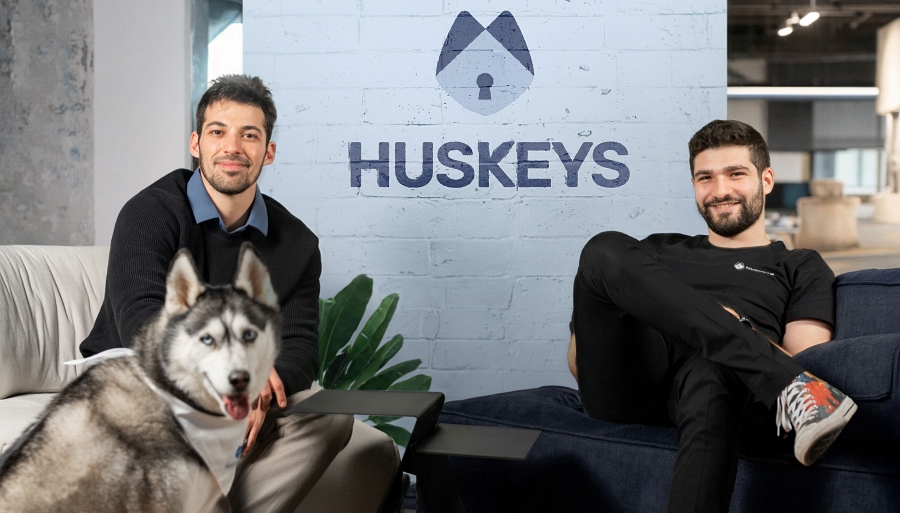
When the young entrepreneurs Itai Gafni and Roy Weisfeld were named, just a few months ago, to Forbes Israel’s list of the country’s most promising young professionals, they were already in the middle of a particularly bold venture: reviving an old, stagnant layer of cyber defense that the global security industry had avoided touching for decades.
Now, the pair is marking an important milestone on the road to realizing that vision. Huskeys, a cybersecurity startup building tools to manage and secure enterprise internet traffic, which the two founded just a year and a half ago, announced today (Wednesday) that it has closed a follow-on funding round led by U.S. investment giant Blackstone – the firm’s first Early-Stage investment in the cybersecurity sector.
The current round (Series A), totaling $27 million, brings the company’s total funding since emerging from stealth five months ago to roughly $35 million, arriving six months after a seed round of about $8 million. The latest round was closed at a valuation north of $100 million, Forbes Israel has learned from industry sources.
Joining Blackstone – the world’s largest alternative asset manager, with roughly $1.3 trillion in assets under management – were strategic investments from Okta and Zscaler, two of the world’s leading cloud cybersecurity software companies. The round also included participation from Merlin Ventures, Skinos Ventures (the fund of Shlomo Kramer and Ishai Yuval), and senior executives from Cloudflare, Palo Alto Networks, AWS, Check Point, Intel, Microsoft and Google.
The strategic investments from Okta and Zscaler represent, according to the company, a partnership designed to accelerate growth, deepen integration between different security solutions and generate greater value for customers – one built, the companies say, on a shared view that the future of the internet will hinge on merging digital identity with autonomous traffic generated by AI agents. Under the partnerships, Huskeys will work alongside both companies’ solutions to let customers combine identity and network data, understand and analyze the behavior of AI agents across the internet, and protect against it – providing a security and management infrastructure built for the next generation of network traffic.
Since going public with its technology, Huskeys has expanded its business, added new customers and deepened its presence in international markets. Its client roster, which today spans significant internet traffic volumes for global organizations, includes well-known brands such as TikTok, Legoland, Ro, Blackstone and Hugging Face.
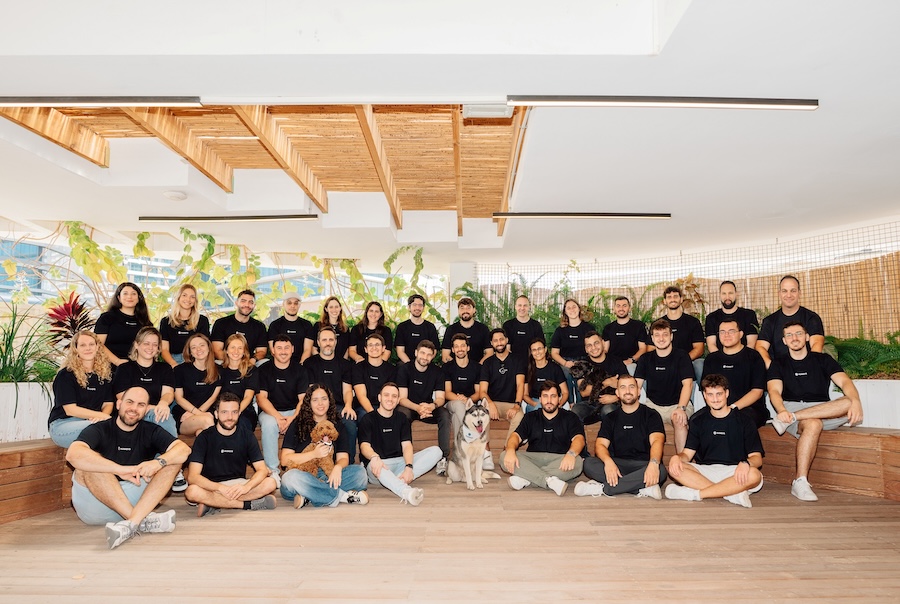
Huskeys, founded in February 2025, has doubled its headcount in just two months and now employs roughly 40 people in Israel. The company says proceeds from the current round will go toward expanding research, development and sales.
A New Security Category for the AI Era
Web Application Firewalls (WAFs) – security tools first developed in Israel in the late 1990s that inspect and filter internet traffic in real time to protect applications from malicious requests – have seen little fundamental change since, and have struggled to keep pace with multi-cloud environments and the speed of modern application development. Poorly tuned rule sets can end up blocking legitimate traffic – translating directly into user churn and lost revenue.
The core technology Huskeys has built isn’t meant to replace existing WAF deployments but to plug into them, through a platform the company calls ESM (Edge Security Management), which monitors rule configurations, analyzes an organization’s traffic profile and recommends tuning and optimization. According to the company, the system analyzes more than a trillion traffic requests daily across tens of thousands of domains.
Having already built a platform that integrates successfully with organizations’ existing WAF systems, Huskeys is now expanding into a broader layer of edge security management – NESM (Network Edge Security Management). It’s a new security category focused on managing and securing “agentic traffic” – a platform that connects an organization’s existing network and security tools, giving security teams a comprehensive view of traffic, the ability to identify risk and adjust defense policy in real time, without replacing existing infrastructure.
Industry estimates suggest that by 2027, non-human traffic will account for roughly 70% of all internet traffic – a shift that makes real-time differentiation between legitimate and malicious activity an existential challenge for organizations. Huskeys’ platform integrates with existing WAF systems rather than replacing them, layering active AI on top that learns an organization’s environment and generates optimized filtering rules in real time. Its virtual-patching capability can block exploitation of edge-layer vulnerabilities within minutes – well before development teams manage to fix the underlying code.
“Every few years in cybersecurity, a company comes along that takes an important space and defines a new category in it,” said Itay Gafni, co-founder and CEO of Huskeys, in an interview with Forbes Israel. “Much like what Wiz did in cloud security, or what Cyera did in data security.” After nearly three decades of stagnation in how organizations manage the network edge, he said, it’s now the network’s turn – the edge security solution Huskeys has built. “Our goal is to do the same thing: build a new category from scratch and change the way organizations secure their networks.”
Adam Fletcher, Chief Information Security Officer at Blackstone, shares that vision: “The way organizations secure internet-facing applications is changing fundamentally. AI-driven traffic and increasingly complex, fragmented edge environments demand a new approach to security management. Huskeys has built a platform designed to operate across any enterprise network, from the smallest and simplest to the largest and most complex, while advancing a new category for modern internet traffic. We believe the company is well-positioned to redefine how organizations manage network security, and we’re glad to support its continued product development in this important category.”
“The Vision Is Starting to Come True”
Huskeys was founded by two 26-year-old entrepreneurs, Itay Gafni (CEO) and Roy Weisfeld (CTO), both graduates of Israel’s elite 8200 intelligence unit, who were named this year to Forbes Israel’s 30Under30 list – and who had already articulated a clear vision at the time: “to fundamentally change the way organizations filter network traffic.”
The global cybersecurity industry is crowded with startups chasing niche solutions, but the two chose instead to take on something close to impossible – reviving an old, stagnant defense layer that organizations had avoided touching for decades: the WAF.
For the founders, the current round’s backing from Shlomo Kramer and Eran Reshef – two entrepreneurs widely regarded as the founding fathers of the WAF – serves as important validation of the solution Huskeys has built, one they describe as “a natural and necessary extension of that legacy defense platform, building a new, complementary layer suited to the technological future.”

“When we founded the company, we were among the first to recognize how AI was going to change the internet,” Gafni said. “Everyone asked us why we were choosing a space that people had tried to solve for years and eventually gave up on, instead of jumping on whatever the trend of the moment was.” Today, he said, the answer is clear: “AI is changing the game from both directions – AI agents are becoming a significant share of legitimate traffic, while attackers are using AI to find and exploit vulnerabilities faster than ever before. In that reality, the network becomes one of the most important layers of defense in the organization – and we’re already starting to see new startups entering the space.”
Gafni grew up in Macabim-Reut, in what he describes as “a tech household” – his father runs a technology company. He enlisted in Unit 8200 and, toward the end of his service, founded a startup that shut down after October 7, when he was called up for reserve duty. Weisfeld, who grew up in Seattle and California following his father’s extensive tech career at Microsoft, caught the entrepreneurship and computing bug early in childhood, worked in robotics in high school, and also enlisted in Unit 8200.
The two clicked during their shared military service, where Gafni led AI-driven innovation projects while Weisfeld worked as a security researcher specializing in web exploitation. In February 2025, just a year and a half ago, the two founded Huskeys and posted a remarkable early milestone: within a month of launch, the company closed a seed round of several million dollars from leading funds and a wide range of investors, including several from the world of sports – among them footballer Mario Götze, NFL legend Larry Fitzgerald, and The Players Fund, the successful UK-based investment firm that partners strategically with soccer clubs Juventus and Como 1907 and counts stars like Harry Kane and Kai Havertz among its investors.
“We didn’t go out to raise money – the money came to us,” Gafni admits. “Over the past few months, demand grew faster than we’d planned. We doubled our headcount and moved into more customers and markets. Once we realized we had an opportunity to accelerate our plans and build a global company leading a new category, we decided to take the money and run faster.”
“Our vision is to build the next great cybersecurity category, one that brings an entire market with it,” he said. “We’re already seeing new players enter the space – and to us, that’s a sign the vision is starting to come true.”