
Imagine you are booking your honeymoon. The resort’s listing says partial sea view. There are photographs online, and an AI model can read every one of them, but the same room is sold under a different name by each of the dozens of suppliers that carry it. None of that answers the only question you actually have: how far you will have to crane your neck to see the water.
Steven Borukhin thinks that question explains why his industry is still growing. “If I’m traveling for my honeymoon and I’m looking at a room that says partial sea view, I want to know exactly what that means,” he told me on the Autonomous Podcast. “I want to talk to someone that stood in that room.”
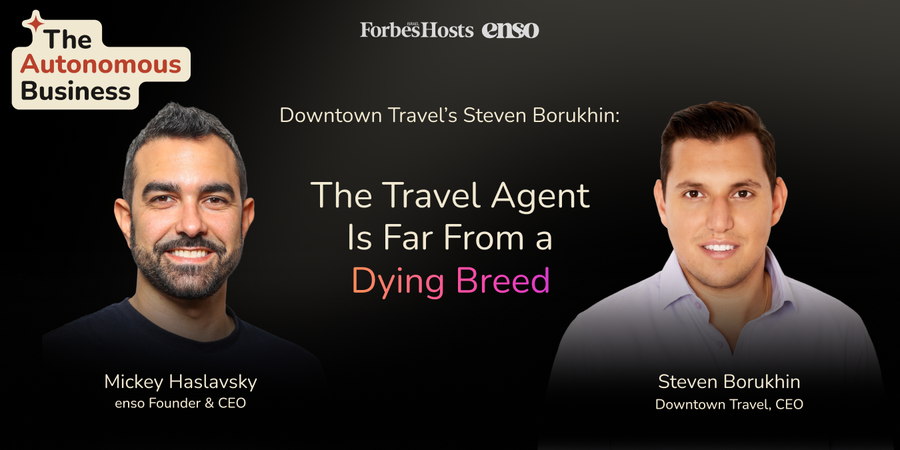
Borukhin is the CEO of Downtown Travel, which opened in New York in 1988 as a small retail agency and grew into one of the largest air consolidators in the United States. Consolidators are the wholesalers of travel: they negotiate fares and hotel rates that small agents could never win alone, then hand those rates to the agents along with the technology to book them. Downtown Travel holds contracts with more than 100 carriers, and Borukhin says it supplies 42,000 independent agents. Last year he moderated the United States Tour Operators Association’s session on agentic and operational AI for travel companies.
What followed was a conversation that kept returning to a single dividing line. Borukhin laid out where AI already does an agent’s work better than the agent, explained why the economics of airline and hotel systems cap how far an AI agent can search, described the corners of travel that refuse to be digitized at all, and made the case that the travel agent is far from a dying breed. The common thread: AI is taking the work the customer never sees, and the part the customer actually pays for is staying with people.
The Front Office and the Back Office
Borukhin divides a travel agent’s job into two halves, and almost everything else he said follows from where he draws the line between them.
The front office is the relationship: the agent dealing with the customer, the knowledge of a destination built over years, the judgment about which room suits which couple. The back office is everything around it. Building itineraries, booking flights, comparing rooms and flight options, upsells, invoicing, working through the inbox. “All of this automation is available out there now,” he said. That second half is where he thinks agents should be pointing AI.
His example is mundane, which is the point. A reservation code arrives inside an email. An AI system connects it to the client’s record, works out whether this traveler leaves in an hour or in two weeks, and reorders the agent’s day around the answer. Post-booking work, and anything else not tied to the relationship with the customer, “is where I really see AI dominating the space,” he said.
The front office is where he expects AI to struggle, and his reasons come out of what changed after COVID. The first is trust in a crisis. Travelers who lived through the pandemic’s cancellations learned to ask whether an online support channel would actually help them on the day a trip fell apart. The second is the hunt for something nobody else has. “People don’t really want to post their Paris trip,” he said. “They want to post their off-the-beaten-path restaurant that they found somewhere in the middle of Provence that maybe none of their friends have been to.”
Neither need has much to do with price, and the industry’s own research points the same way. In a January 2026 survey of more than 1,500 US travel advisors, Phocuswright found that only 2% of their clients book with them because they offer the best price. The same research found travel agency sales outpacing the overall travel market. Borukhin put it more bluntly from inside the business: coming out of COVID, and still today, growth in offline travel purchasing has outpaced online.
I asked him whether the tools have already produced a superhuman travel agent, one person armed with AI serving ten or a hundred times as many customers. He sees the seeds of it, but only at the simple end. A couple spending a weekend in Paris at a Marriott, a standardized property, is a trip an AI can handle. Ask a model to plan a day around Louis Vuitton stores and it will probably draw you a walking map. What it will not do is make the restaurant reservations, or contact the hotel concierge to book a slot at the Louvre so you are not waiting in line. “When it comes to actually booking you experiences, I think that’s where it’s gonna lag a bit,” he said.
He also knows which side of the line he wants the chatbot on, and he admitted his interest openly. “From a selfish perspective,” he said, “I don’t believe that the chatbot solution to actually selling your customer is necessarily where I think the best place for travel to go is.” The relationship is the part of the job he hopes stays a person talking to a person. The rest can go to the machine.
A Customer and a Computer
The people on the human side of that line are not who most readers picture when they hear the words travel agent.
Downtown Travel exists because airlines and hotel groups do not invest in sales teams that can reach the long tail of small and home-based agents. Those agents are worth reaching anyway. They fly the routes, stay in the resorts and then sell what they experienced, which makes them, in Borukhin’s description, marketing machines for the suppliers. “They go out, they experience these flights, these hotels, these resorts, and they sell it on the airline’s, the hotel’s behalf,” he said.
The barrier to joining is deliberately low. “If you have a customer and you have a computer, you could be a travel agent,” he said. Host agencies and consortia, which he described as clubs for travel agents, sell that idea as a business in a box. At one end of his network sits someone who has been to Paris every year for twenty years, books a couple of tickets a year for friends, and earns a couple of thousand dollars in commission to pay for their own vacation. At the other end are full-time agencies issuing a hundred tickets a day.
He credits agencies like FORA with making the job look like something people want to do, through social media, through community, and through the small gatherings new agents now host for their own neighbors. “It used to be the desk warrior, right?” he said. “Staring at a blinking cursor.”
A base that wide shapes what a supplier uses AI for. Downtown Travel does not teach its agents how to prompt Claude or ChatGPT, and Borukhin does not think that is its place. His advice to a new agent is to ask the model directly. “Prompt it and say, hey, I’m a new travel agent, like, what are the best ways to use you?” What comes back, he said, is generally pretty effective.
The company’s own AI goes into support, response times, and the videos, webinars and pamphlets that teach a constant stream of newcomers how net rates differ from commissionable and published fares, and why a single flight can carry 17 different booking classes. Its booking engine, TheBestAgent.Pro, shows the commission on each fare and gives the agent a box to add a markup to each hotel room.
Every Search Has a Price
At enso, our working assumption is that AI agents have opened up a new kind of marketing because they can do what people physically cannot: read a hundred subreddits at once, run every possible Google search at the same time. So I asked Borukhin whether the same capacity could produce a new kind of travel, with an agent booking several hotels at once and waiting for the prices to fall.
He started with the hotels’ point of view. “While that might be a good user experience, the hotels are gonna hate that, right?” The reason is a ratio most travelers have never heard of. Look-to-book measures how many searches a platform runs for every booking it actually makes, and every airline and hotel group works to keep it low, because each search costs them servers and bandwidth. An AI agent hunting for the lowest price drives that ratio in exactly the wrong direction. “Look to book in relation to AI are at odds,” he said. “AI wants to search as much as possible.”
Suppliers, in his account, do not have the capacity for a world of more than 5,000 looks for every booking. Until their systems can absorb that load, AI agents will be held to a limited amount of searching, however capable the models behind them become.
The lesson reaches well past travel. The capacity that makes an AI agent so valuable in marketing turns into a cost the moment it lands on someone else’s infrastructure. That someone else gets a vote. For any company deploying agents at scale, the ceiling is often set by the systems those agents query.
The Long Tail Does Not Want to Be Found
A listener who knows the travel business sent in the sharpest question of the episode. Travel runs on a long chain of intermediaries, starting with the global distribution systems (GDSs, the marketplaces that push airline and hotel inventory out to agencies and online travel companies), and each link takes a piece. If an AI agent can contact a hotel directly on a traveler’s behalf, does the chain collapse?
For a large chain hotel, Borukhin said yes, at least for the communication. He has seen plenty of companies offering robotic phone services and AI-written emails that make asking a hotel a question quicker and more efficient. That part, he expects, will arrive.
The harder case is the part of travel people prize most. His example was restaurants in Tokyo: highly fragmented, many without a website, some without a phone number, reachable through relationships with hotel concierges, and selective about which diners they will take. “Hugely long tail,” he said, and he put renting a gulet on the Turkish Riviera and finding a hidden beach in Mallorca in the same category. “They don’t want to be AI-enabled. They don’t want to be known. But that’s what travelers are seeking out.” If the destination itself refuses to be part of AI, there is only so far AI can reach.
Trust follows the same rule, and it is less forgiving with machines. “The one time an AI will suggest a hike that leads that hiker into a dangerous situation is the last time they will ever use that platform,” he said. Human agents face the same test, which is why they prefer to sell what they have experienced themselves. Downtown Travel runs familiarization trips, fam trips in the trade, nearly every month, flying agents to destinations so they can walk into the rooms and look at the views they will later describe to a client.
The higher the stakes, the stronger the effect. An expedition cruise to Antarctica turns on the weather, the vessel and the people leading the expedition, and he expects it to take a very long time before travelers trust AI with a trip like that, no matter how many Reddit threads they read. “At the end of the day, they wanna hear a human voice that’s gonna hold their hand and be like, hey, it’s gonna be okay,” he said. “This is gonna be the adventure of a lifetime. Let’s do it.”
He does not rule out the other future. “Listen, is there a world where we’re all Joaquin Phoenix in Her, right, speaking to our pockets? Yes,” he said. He simply does not see it soon. In his view the drive to be unique outweighs it, and the activities, places and ways of getting there are still too fragmented for any AI to connect into one picture it understands.
Someone Who Stood in the Room
“There is the stereotype that, why use a travel agent, travel agents are kind of a dying breed,” Borukhin said near the end of our conversation. “But from our perspective and from the numbers we see, it’s far from the case.”
The split he describes is cleaner than most AI forecasts. The machine takes the inbox, the itinerary, the invoice and the reservation code buried in an email. The person keeps the relationship, the judgment, and the hand to hold when a trip goes wrong. Supplier systems decide how far the machine can search, and a restaurant in Tokyo decides whether it gets in at all.
Somewhere a couple is looking at a listing that says partial sea view. An AI can read the photographs, compare the suppliers and book the room in seconds. It still cannot stand in it.
Mickey Haslavsky is the Founder and CEO of enso and a Forbes 30 Under 30 alumnus. He previously founded Rapid (acquired by Nokia) and hosts The Autonomous Podcast, in partnership with Forbes Israel.