Imagine someone whose entire job is walking to the copy machine. Every morning, the same routine: collect documents, copy pages, distribute stacks. One day, computers arrive at the office. He sees them being unboxed. He watches them get plugged in. Everyone in the room understands what is about to happen. He does too.
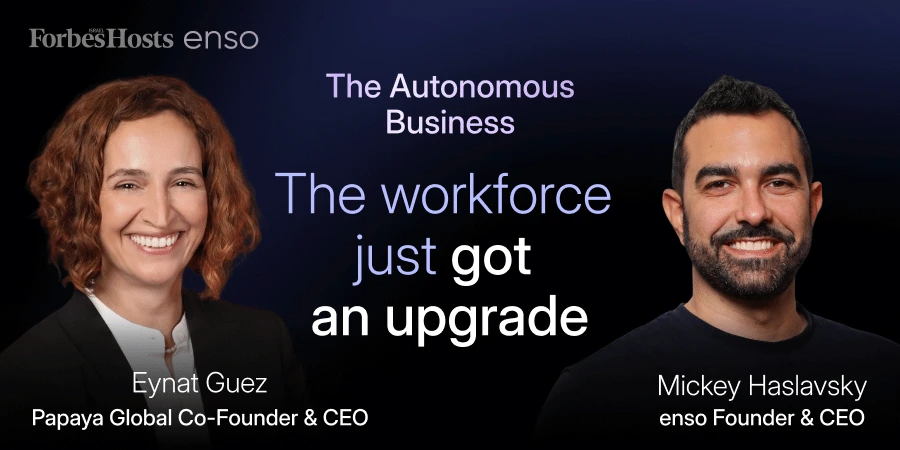
Now multiply that across every department, every role, every company on earth. That is the image Eynat Guez painted when she sat down with me on the Autonomous Business Podcast, in partnership with Forbes Israel. Guez is the Co-Founder and CEO of Papaya Global, the leading enterprise platform for global workforce management and payments, operating across more than 160 countries. She is also the first woman in Israel to lead an Israeli-founded startup to a valuation exceeding one billion dollars. She has spent eight years building infrastructure for the most regulated, most fragmented, most thankless layer of the global economy: cross-border payroll. And she believes we are about to redesign all of it.
“This is the real first time in history where we’ve been promised to get some time back and we can actually make it happen,” she told me. “With AI and with agents, this is completely different.”
Who Pays the Tax When the Worker Is a Machine?
There is a question hiding inside the AI revolution that almost nobody is talking about. If AI agents replace human workers at scale, who pays the payroll tax?
Guez sees this more clearly than most because she sits at the exact intersection where it will hit first. Papaya currently manages three categories of workers: full-time employees, contractors, and contingent workers. I asked her whether a fourth category is coming. “Yes, surely,” she said. “We presented our 2030 vision recently and the orchestration that we are building, the ability to manage a fully agentic workforce, is already there.”
But the infrastructure question is only half of it. The political question is bigger. “It will be fair to assume that governments will not very happily decide to just waive payroll taxes from agents,” Guez explained. “This is a source of income. Every country needs those taxes. So we will start seeing new rules, payroll compliance and eventually regulation that is related to autonomous agents and to companies that will be paid different types of taxes for autonomous work.”
Follow the logic: governments fund social services, healthcare, pensions, and infrastructure through payroll taxes collected from employers and employees. When agents absorb work that humans used to do, that tax base erodes. Governments will not absorb the loss. They will create new tax categories, new compliance requirements, and new reporting obligations for companies deploying AI agents. The question is not whether this regulation will come, but how fast. Guez believes we could see the first frameworks within 12 to 24 months. And every company currently racing to automate without thinking about the compliance layer that follows is setting itself up for a painful correction.
This is the part of the AI conversation that the headlines are missing. The cost of an agent is not just tokens and compute. It will eventually include taxation, regulatory compliance, and governance structures that do not exist yet. Guez is building for that world. Most companies are not.
The Advantage Is Real. It Is Also Temporary.
I brought up a debate that comes up in nearly every conversation I have with founders. One camp says AI agents will shrink companies. Fewer humans, more machines, leaner operations. The other camp, which is where I sit, says the opposite: because each person can do so much more, competition will intensify and companies will hire more, not fewer.
Guez sided with growth, but added something I was not expecting. “We probably have a year, two years of an advantage for the early adopters,” she said. “But they will get it. They will catch up. This is how the world works. We’ve seen it on Web 1, Web 2, mobile devices. Companies are moving. It just depends on the pace.”
This is a genuinely contrarian position. Most of the AI discourse assumes the gap keeps widening, that the companies that adopt first will compound their lead indefinitely. Guez is saying no. The advantage is real but it flattens. Within a few years, every company will have agents running their operations, and the playing field resets. What matters is not just whether you moved first, but what you built during the window that cannot simply be replicated once everyone else catches up.
What excites her most about this period is not efficiency. It is who gets to build. “This is the first time where non-engineer and non-tech people can rise up,” she said. “We see it inside Papaya. People that all of a sudden within six months become monsters of AI, creating crazy things. Everything that was their blocker, because they needed an engineering team, they needed some tool they couldn’t access, are becoming amazing contributors.” Her summary was blunt: “This is the era of builders.”
“Use AI” Is a Slogan. This Is 2026.
Guez has no patience for how most companies approach AI adoption. The pattern is familiar: leadership sends a message telling everyone to “use AI.” Employees nod. They rephrase a few emails with ChatGPT. Nothing structural changes. “‘Use AI’ is not management attention,” Guez said. “That’s a nice slogan, but this is 2024. We are in 2026. This is not enough.”
What Papaya did instead was specific and methodical. Every department mapped its daily tasks. Which ones are repetitive? Which are follow-ups, research, admin? Those became the first automation targets. Marketing went first because it was the path of least resistance: large budgets, no private data exposure, measurable output. “All of a sudden people saw that we can do two times more, three times more, ten times more with the same budget. And then the other departments started asking: how did you do that?”
But Guez was equally clear about the guardrails. “Builders that are non-technical can do things without understanding the consequences of connecting an external agent to a database,” she warned. “The consequences can be massive to organizations. You need to be the kid and try things, but you also need to be the responsible adult and say, hey, this is dangerous.” Papaya now runs an internal target of 3x efficiency across the organization by year end. They are currently at 1.5 to 2x in many departments. The target is aggressive. The approach is not reckless.
You Are Not Losing Your Job. You Are Losing Your Responsibilities.
Every time we deploy AI systems at enso, the same question surfaces. People see agents arriving to handle parts of their function and they ask, sometimes out loud and sometimes with their body language: am I about to be replaced?
Guez reframed it in a way that I think every leader should borrow. “You’re about to lose your responsibilities that are associated with this job. So now let’s rewrite your roles and responsibilities.” She has been hearing this question for eight years, since before the AI wave, when Papaya first started automating payroll processes for clients. “We were selling payroll managers the future of payroll and they were like, but I do those things currently, what am I going to do tomorrow morning.”
The answer then was the same as the answer now: we take the friction, the repetition, the stress of not knowing if you will make it on time or if you made a mistake. What remains is the strategic layer. In the past three years, payroll has evolved from a back-office function to a leadership role in many organizations. The same thing will happen across every function that AI touches. The execution disappears. The judgment stays.
What Guez will not tolerate is avoidance. “When no one is talking about it, living it as the elephant in the room, this is the worst thing,” she said. “Because then you have people that are eager to fail this. And it is very easy to fail something if you don’t want this to happen.” The sabotage is not malicious. It is human. People protect what they know when they feel threatened by what they do not understand. The only antidote is honesty.
The Org Chart Is Now an Architecture Diagram
Near the end of our conversation, Guez offered a metaphor that reframes how companies should think about every hire from this point forward. “It’s much easier to gain weight than to lose weight,” she said. “Every person you bring into the office, it’s much harder to make their role redundant afterwards. Because they’re already doing something.”
Then she said the line that I have not been able to stop thinking about since we finished recording.
“Every single CEO and founder starting a company needs to think very clearly how every single employee has an ROI over their head. And anyone that cannot generate ROI to the organization is an agent. Agents need to do a lot of things that are in the back office, but people need to bring ROI.”
This is not a prediction about 2030. This is a design principle for today. The org chart is no longer a hierarchy of reporting lines. It is an architecture diagram. Every role is either a human node that generates strategic value through judgment, creativity, and relationships, or an agent node that executes repeatable processes at speed and scale. The hiring decision is now an architecture decision.
We are closer to 2030 than we are to 2020. That fact alone should change how every leader thinks about the next twelve months. Guez has built one of the most complex operational platforms in the world, and she is rebuilding it around a workforce that is part human, part autonomous, and governed by regulations that have not been written yet. The companies that design for this reality now, while the window is open, will define how the next era of work actually works. The ones that wait will spend years catching up to a world they could have helped build.
Mickey Haslavsky is the Founder and CEO of enso and a Forbes 30 Under 30 alumnus. He previously founded Rapid (acquired by Nokia) and hosts The Autonomous Business Podcast, in partnership with Forbes Israel.