This year marks the 100th anniversary of the 9-to-5 work week. Before it existed, people worked seven days a week during all waking hours. Its invention followed a period remarkably similar to this one: humanity believed the assembly line would displace workers altogether. That fear created an uncomfortable stretch of time. But we know how it ended.
Micha Kaufman, Founder and CEO of Fiverr, sees the parallel clearly. “The major difference right now is it feels more intelligent and it happens much, much faster,” he says. Kaufman is not trying to calm anyone down. He is trying to get them to pay attention.
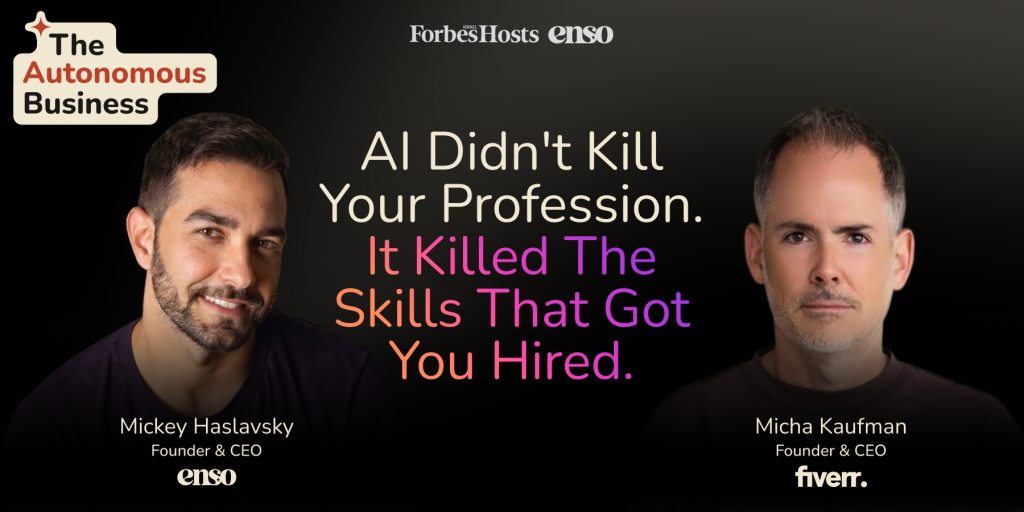
Mickey Haslavsky hosts The Autonomous Business Podcast, a Forbes Israel partnership exploring how AI is restructuring companies from the inside out. Haslavsky sat down with Kaufman for a conversation that moved between philosophy, org design, and the uncomfortable truth about what happens when a CEO takes his own advice seriously.
In April 2025, Kaufman sent an open letter to his entire company. It went viral. The message was blunt: AI is coming for every role, including his own. Within the year that followed, he eliminated three layers of management, restructured Fiverr from the inside out, and landed on a thesis that most corporate leaders would never say in public. The optimal team size, he believes, is one person.
The Biological Computer
Kaufman opens with a framework that sounds more like a thought experiment than a business strategy. Human beings, in his view, are biological computers. We process inputs through sensors, run them through biological algorithms, and produce outputs. The difference between us and digital computers is not capability. It is complexity.
“We’re just biological computers and we don’t understand how we work. We didn’t design ourselves, which makes it really hard to explain how things happen.”
The comparison is not meant to diminish what humans are. It is meant to clarify what they are uniquely good at. Kaufman runs through the limitations: biological agents expire, need sleep, cannot parallel process, cannot digest massive amounts of information quickly. They carry ego and emotion, systems designed for self-preservation, not productivity.
Digital computers have none of these constraints. They do not lose memory. They do not need rest. They can run a thousand processes simultaneously.
But when Kaufman maps out the attributes that remain exclusively human, everything distills into a single word: judgment.
“Creative thinking, sense of taste, sophistication, different points of view. All of these are judgment. You can collapse this into one term. This is our place.”
The Memo
In April 2025, Kaufman sat down and wrote a memo to his employees. It took nine minutes. No AI was involved. The words came easily because the idea had been boiling inside him for months.
The memo told his team, in direct terms, that AI is coming for their jobs. Not some of them. All of them. Including his.
“I didn’t want to sugarcoat it. I didn’t want people to misread this as, okay, another memo, whatever. But seriously, to tell people: look, you’re standing on the road and a car is going to hit you. Can you please step aside?”
The initial reaction inside Fiverr was not a warm one.
“I can just imagine what my team must have felt. Probably it was: what the hell just happened?”
Kaufman acknowledges the harshness. He does not apologize for it. The memo was designed as a wake-up call, not a threat. It did not come out of nowhere. Kaufman had been having conversations with his team for months, working through the implications together.
“If you want to get run over, I can’t save you. I’m not going to want this for you. But if you have the motivation, I’ll bring you down the moon.”
The distinction matters. Kaufman was not telling people they were going to be replaced. He was telling them that the only way to avoid it was to change how they work. Curiosity, open-mindedness, agility. Without those, he says, “you’re not gonna be hirable. There is no space for you anywhere.”
Velocity, not efficiency
What followed the memo was not a round of layoffs. It was a restructure.
Fiverr is a profitable, well-capitalized public company. The changes were not driven by financial pressure. They were driven by a conviction that the old corporate structure could not move fast enough for what was coming.
The goal was not efficiency in the traditional sense. It was velocity, simplicity, and a flatter organization where decisions could happen faster and accountability was tied to outcomes, not titles.
“I wanted to simplify, flatten, and create a much more open organization and culture. But also to understand how some of what managers used to do could be automated by software.”
Now he makes the statement that would alarm most HR departments on the planet.
“The optimal team size right now is one person.”
The reasoning follows his biological computer framework. If humans are the weakest link in any process, not because they are incapable but because of their biological limitations, then every additional person multiplies the friction. Two people create two weak points. Three create three. The complexity is not additive. It is exponential.
“We’re not synchronous. We’re asynchronous. We need to meet, share our feelings and beliefs and our disagreements. I make it sound like it’s disgusting. But it’s to be human.”
Kaufman is not arguing against collaboration. He is arguing against the assumption that larger teams produce better outcomes. In a world where AI handles execution, coordination, and information processing, the premium shifts to individual judgment, not headcount.
The Floor and the Ceiling
The instinct most people have about AI is that it will replace experts. Kaufman sees the opposite.
“AI elevates the floor. It doesn’t lower the ceiling.”
Everyone now has access to the same tools. A person with no design experience can produce a decent logo. A non-technical founder can build a prototype. The baseline has risen. But the ceiling, the level of work that requires real taste, real expertise, real judgment, has not moved.
“You and I can have Photoshop, but whatever we create with it is very dependent on our skill, experience, sense of taste. We all have the same tools. Which means that none of us has any advantage whatsoever. So what is the advantage? The advantage is human judgment.”
This is where Kaufman’s philosophy meets his management style. If the advantage is judgment, then the way to run a company is to maximize the time people spend exercising it. Not debating. Not aligning. Building. He points to a Fiverr campaign from 2017, “In Doers We Trust,” and believes the slogan is ten times more relevant today than when they first ran it.
The AWS Parallel
If the floor is rising and the tools are the same for everyone, what creates the next wave of growth? Kaufman answers through a specific historical lens: the rise of cloud computing.
Twenty years ago, building a technology company required buying physical servers. You assembled them by hand, installed cooling systems, ran wiring, and by the time the hardware arrived at your office, it was already outdated. Your capabilities were constrained by your capital, your geography, and your access to infrastructure.
Then AWS made computing power available by the cycle. You did not need to own servers. You rented capacity. The result was an explosion of businesses that could not have existed before.
“The one most profound thing that cloud computing did was to democratize computing power. That created a whole economy of new businesses that weren’t possible before. People don’t make that connection. But they actually changed history forever.”
Kaufman believes AI is following the same arc. The technology is accessible to everyone. The cost is declining toward usage-based pricing. The barriers to starting a company are lower than they have ever been.
“What we’re gonna see in the next five years is an explosion of new businesses. And I’m not talking about AI businesses. I’m talking about traditional businesses.”
The comparison has a second layer. When companies shifted from locally hosted servers to the cloud, the transition was chaotic. People declared IT dead. It was not dead. It was changing. The experts who adapted became more valuable, not less.
“You have to embrace this. I don’t care what you do. Because what you do also has functions that could be automated, even if you’re not high-tech. You do booking, payments, scheduling, customer care, shift management, logistics. Every aspect of this. This is the AI transformation.”
The Story You Cannot Automate
When the conversation turns to competitive advantage in a world where AI makes everything accessible, it is Haslavsky who names the differentiator first.
“At some point I realized that the only way to win is just to be an extremely good storyteller as a brand. Every person on planet Earth has to rethink their own story now. If the world is flat, that’s the only way to stand up.”
Kaufman picks up the thread and takes it further, connecting it to his biological computer thesis. If judgment is what makes humans unique, and everyone has access to the same digital tools, then the differentiator is not what you can do. It is who you are. Your experiences, your frameworks, your specific combination of decisions and failures and insights.
“What makes me special? Not the generic question about what makes human beings versus animals versus computers special. It is: what is your story? What makes you you, and how can you build out of it to create incredible things?”
For Kaufman, Fiverr’s legacy is not just the platform itself. It is the ecosystem the platform created. The companies built by former Fiverr employees. The freelancers who turned side projects into full-time careers. The businesses that accessed talent they could never have afforded to hire.
“I’m even prouder of the companies that were created out of Fiverr by Fiverr team members than I’m proud of Fiverr itself. Because I think that this is the legacy. The life that you create that takes a life of its own.”
The conversation ends where it started: with an admission that nobody knows what comes next. But Kaufman is not paralyzed by that. He is building.
“We’re still in this twilight zone of AI. But it is going to change every tech company and every brick-and-mortar. And it’s going to create so many more. That makes me optimistic and excited.”
Mickey Haslavsky is the Founder and CEO of enso and a Forbes 30 Under 30 alumnus. He previously founded Rapid (acquired by Nokia) and hosts The Autonomous Business Podcast, in partnership with Forbes Israel.